Fort Larned was established in 1859 to protect travelers on the Santa Fe Trail from Native Americans. Originally situated three miles from where you’ll find it today, it was first known as Camp on Pawnee Fork and Camp Alert before settling on Fort Larned, in honor of Colonel Benjamin F. Larned, the paymaster general of the United States Army at the time. Soldiers and civilians who died from war, wounds, disease, or other causes were buried on site.

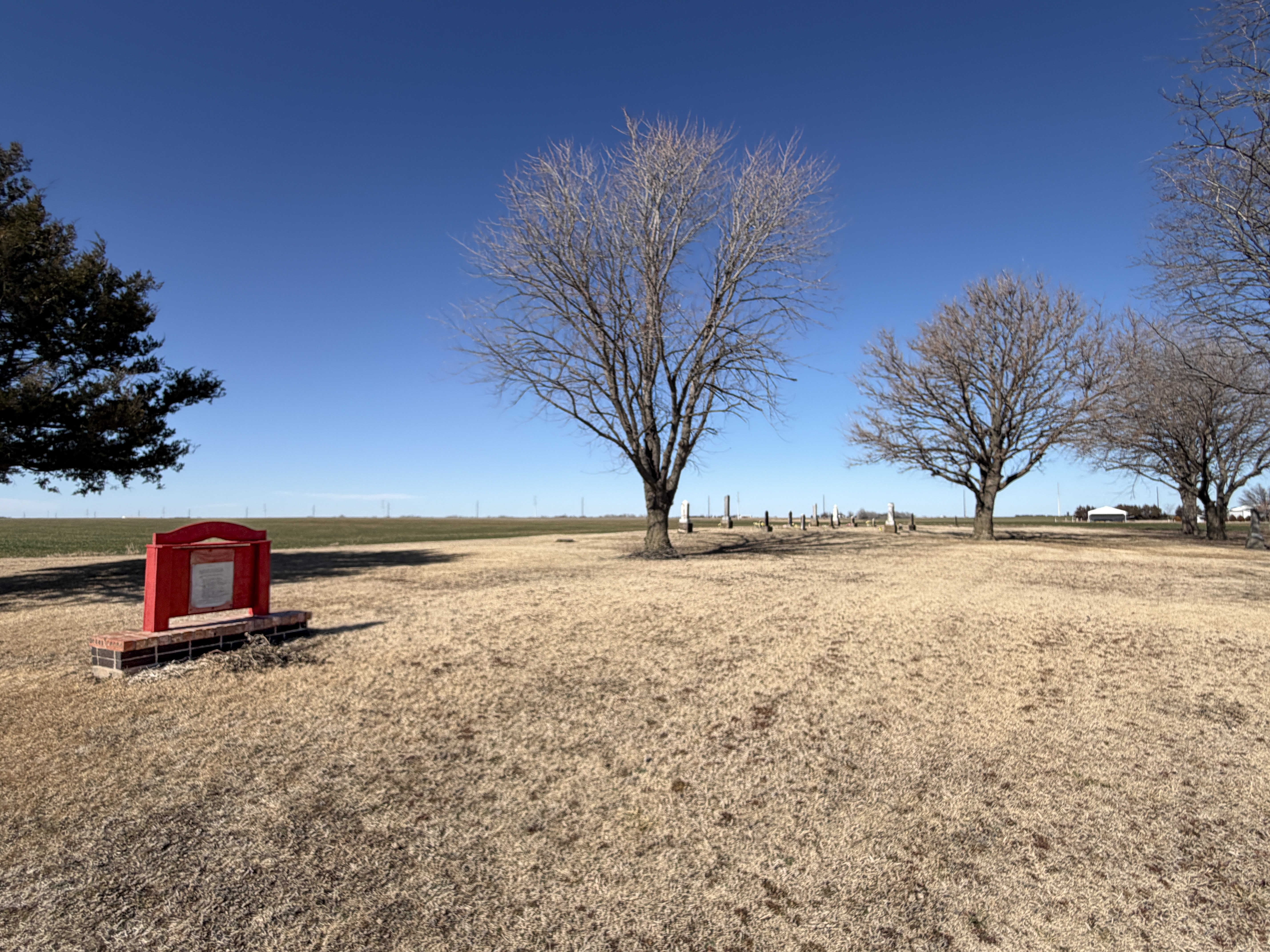
The National Park Service wrote a wonderful piece about the cemetery, which can be found here. It tells us that this is a commemorative cemetery, established in 2009, and it marks the site of Fort Larned’s original cemetery.

Fort Larned Post Cemetery was located here from 1860 to 1869, and then it was moved to another part of Fort Larned that was on higher ground.
In 1869, due to flooding and a prairie fire that destroyed the wooden markers there, the Post Commander ordered another cemetery established in what he considered a better location northwest of the fort. National Park Service

Fort Larned was abandoned in 1878, and so was the cemetery. In 1888, the remains of the soldiers who were buried at Fort Larned were exhumed and moved to Fort Leavenworth National Cemetery. The civilian bodies were supposedly left behind.

There is a plaque at the cemetery with a footnote that acknowledges that an unknown number of civilians remain buried here, only one of whom is known by name. When Fort Larned served as a headquarters and annuity distribution site for the Indian Bureau, Little Heart, a Cheyenne (Tsétsêhéstâhese) was shot and killed by soldiers buried at Fort Larned. Little Heart and the other people buried somewhere at Fort Larned died between 1860-1878.

While the National Park Service says the soldiers buried here were moved, a careful reading of the plaque suggests that they don’t really know who was moved and who was left: “Dedicated to the soldiers who died while serving their country at Fort Larned, Kansas (1859-1878). In 1888, remains were relocated from the post cemetery to Fort Leavenworth National Cemetery, Section B, where they were not identified. Among the men who perished at or near Fort Larned and whose remains may now be buried at Fort Leavenworth are:” followed by the names of 62 soldiers.

In 1886, two years prior to the removal of bodies from Fort Larned to Fort Leavenworth National Cemetery, it was reported that it was “impossible to identify the graves of any except Col. McIntyre” and and that there was “no possible means of identifying any of the graves.”

Another article from 1888 suggested that two soldiers could be identified: C.E. Campbell and Franklin Whitson. The articles from the time period confirm that we really don’t know whose remains were moved and whose remains still rest at Fort Larned in unmarked graves. Among those civilians who may still be buried here include Dr. A.M. Squires and A.H. Hallowell who both died of cholera at Fort Larned.

A prominent feature of this cemetery is a large obelisk carved from native stone by soldiers at Fort Larned in honor of those who died in service. Just like the cemetery, this monument has traveled around. It was placed at Fort Larned in 1867, moved in 1886 to the Larned Town Cemetery, and then moved back to Fort Larned in 2009.

A plaque at the base of the monument tells the history of the monument, including a transcription of the only inscription that wasn’t lost to time: “J.B. McIntyre, Col. USA died at Fort Larned, Kansas May 9, 1867, was one of the officers, of extra duty, maintained the honor of his country gallantly during the days of the recent rebellion.” Coincidentally (or maybe not), Col. McIntyre’s grave was the only one The Larned Chronoscope Daily said could be identified in 1886. Perhaps they were referring to this monument.

We found the inscription quite difficult to read, and some of the words now missing.

Some of it is still preserved, as well as some of the artwork the soldiers carved into the stone.

If you are visiting Fort Larned Post Cemetery, you will want to stop inside the visitor’s center located within the heart of the Fort. In here you can view the original gravestones for two civilians who died at Fort Larned and are presumed to still be buried here, either northwest of the fort or at the original cemetery site (now the commemorative cemetery site): Margaret Bothwell, a soldier’s wife who died in childbirth, and Peter Collins, a laborer who died from cholera.

You can also view an old map of Fort Larned, one of the only existing records of the layout of the Fort from the time it was in use.

The original cemetery is marked as a “grave yard,” and is prominent on the map.

Additional Resources
Fort Larned Cemetery, Find a Grave
Fort Larned Post Cemetery, National Park Service
A Final Resting Place – The Fort Larned Post Cemetery, National Park Service
Fort Larned National Historic Site, Wikipedia
The Story of Fort Larned by William E. Unrau, Kansas Collection: Kansas Historical Quarterlies
Soldiers Who Died at Fort Larned, Historical Marker Database
Exploring Historic Fort Larned, Larned KS, and the Santa Fe Trail Center, Travel with a Wiseguy
1974 Excavations at Fort Larned National Historic Site Kansas
Fort Larned National Historic Site, SheaOliver.com
A Letter to St. Louis, Kansas National Democrat, Lecompton, KS, Dec 29, 1859
Another Indian Raid Upon Fort Larned, The Leavenworth Times, Leavenworth, KS, Jul 27, 1864
A Letter from Camp Alert, The Weekly News-Democrat, Emporia, KS, Jul 7, 1860
More About The Cholera, Journal and Courier, Lafayette, IN, Jul 30, 1867
Indian Affairs, The Philadelphia Inquirer, Philadelphia, PA, Sep 2, 1867
The Plains Indian Peace Commission, The Weekly Telegraph, Macon, GA, Nov 1, 1867
Centennial History of Pawnee County, The Larned Chronoscope Daily, Larned, KS, Jul 7, 1876
Fort Larned Cemetery, The Larned Chronoscope Daily, Larned, KS, Apr 30, 1886
Captain J.S. Welch, The Larned Eagle-Optic, Larned, KS, Apr 30, 1886
Fort Larned Cemetery, The Larned Chronoscope Daily, Larned, KS, Jul 2, 1886
Carefully Conveyed, Larned Chronoscope, Larned, KS, Jan 6, 1888
First cemetery will be featured Sunday at Forts Visitor Center, Great Bend Tribune, Aug 9, 2012


Share your thoughts