Four years ago—December 31, 2021—I started this blog and other social media pages under the name Midwestern Death Trip. And what a trip it’s been! Let’s take a little stroll down a tragic memory lane and revisit some of the articles and events over the last four years.
MOST READ
The Murder of Mary Glass published July 6, 2022

The Murder of Mary Glass is the most read article on this blog to date. Mary’s story has been told before, but not in the most accessible ways (behind a paywall or not digitized). I first stumbled across Mary’s story while reading old newspapers. I spent countless hours reading and researching Mary, and piecing the story together from old newspaper articles and other resources.
Mary Glass was just 14 years old and noticeably pregnant when she went missing the evening of March 24, 1916 from Coffeyville, Kansas. She was employed by local farmer Abe Cline, and several eyewitnesses claimed to have seen Mary that evening with his brother, Dave Cline Jr., in his Buick roadster shortly before she disappeared. Her body was found six weeks later in the Verdigris river, about a mile down the river from the old Cline farm, along with the body of a fully developed baby. She appeared to have been strangled with wire identical to baling wire found on the Cline farm, and her body had been weighted down and sunk into the river before breaking free and resurfacing.
Within days of Mary’s body rising to the surface, Dave Cline was arrested and charged with murder. After a sensational trial that captivated the attention of Montgomery county for months, Dave was acquitted by an all-white, all-male jury.
The article I wrote caught the attention of Kerri Hurley of Coffeyville, who worked with Barnes Monument to obtain a marker for Mary’s grave. Harold Mann Insurance Agency funded the QR code on Mary’s gravestone that links to the article I wrote, which you can read here.
The Forgotten Four published February 7, 2023

The Forgotten Four is the second most read article on the blog, which covers the brutal murders of Raeshawnda Wheaton (18), Quita Ford (18), Jermaine Levy (19), and Quincy Williams (17). When the quadruple homicide occurred, it was the city of Wichita’s worst multiple killing in almost 27 years.
Before these four were even buried, another crime spree had already begun that would end in another quadruple murder a few days later. [The Carr brothers] crime spree would be called “the Wichita Massacre” or “the Wichita Horror,” and for many, it overshadowed the first quadruple murder of four teenagers. Every time the murders of Raeshawnda, Quita, Jermaine and Quincy are discussed, so are the others.
The victims of the second quadruple homicide were white, and instead of two quadruple homicides being the focus, just one story dominated the news. Raeshawnda, Quita, Jermaine, and Quincy were dubbed “the forgotten four” after the second homicide took precedence in the media and the public. I remember all the sensation around the Carr brothers murders, I even remember hearing the verdict read live on the radio. But I had forgotten about these four people, like most of us did. It’s time to remember. You can read more about the forgotten four here.
Prehistoric Mounds and Archeological Sites of Kansas published May 15, 2024

Prehistoric Mounds and Archeological Sites of Kansas is the third most read article on the blog, and I’ve also noticed that readers tend to read the resources and links included as well. I took considerable time putting the amateurish information together and it makes me so happy to know that others are using it as a resource for their own research.
According to A Standard History of Kansas, “there never was a systematic exploration of the known mound and ancient Indian village sites of Kansas, and a large part of those which were first noticed when the state was settled have been obliterated by the cultivation of the soil or by the acts of careless despoilers and most of the valuable relics were lost or scattered.”
The mounds and elevations that were not flattened by settlers or destroyed in the name of progress (or amusement) are just hills to most Kansans today. But our state is still very rich in archaeological sites—about 15,000 or so that we know of.
My husband and I drive around pointing at hills and mounds wondering if ancient people are buried there. We look at the progress and advancement around us and wonder what it was built on top of. My blog article, which you can read here, only scratches the surface of these ancient sites that we live on today.
Buried at Cessna: The Mysteries Surrounding Little Lyn Wyckoff published February 3, 2024

Buried at Cessna: The Mysteries Surrounding Little Lyn Wyckoff is the fourth most read article on my site, and as far as I know, Lyn’s grave is the only single grave cemetery in Wichita.
In 1955, surveyors discovered the gravestone of a three-month-old boy named Lyn Wyckoff who died in 1881. The gravestone says the child was the son of Mollie F. Wyckoff, and bears the Kimmerle & Adams makers mark.
After its discovery, surveyors preserved the gravestone by putting a fence around it and incorporating it into the landscaping. In 1975, Cessna Aircraft employees put a white picket fence around the gravesite. Today, the grave is protected with a wrought iron fence.
I don’t solve any mysteries in the article, and we still don’t know who Lyn’s father was, but I did (I think) bring more awareness to this unique gravesite in an unexpected place. You can read about it here.
A FEW OF MY FAVORITES
These articles may not be among the most read on the blog (yet), but I really enjoyed the research, discovery, and writing process behind these stories in particular.
Grave Mistake in Garden Plain? published July 11, 2024

Grave Mistake in Garden Plain? was an adventure for me. It started off pretty normal: photographing gravestones and doing some research to find out who the people are beneath the gravestones. Then I stumbled across something that didn’t make sense: the miliary gravestone I was researching in Garden Plain matched a man who had a gravestone in another state and had no verifiable ties to Garden Plain. Digging a little deeper, I found a second military gravestone in Garden Plain that matched a man who lived somewhere else in Kansas.
First, I convinced myself that I was wrong. I must have gone down the wrong rabbit hole in my research, or maybe I was missing a key clue. It started to drive me a little crazy. I asked around online. Then I started making phone calls. I drove back to Garden Plain to see if I could look through old newspapers or speak to certain individuals in person. I also ordered military records for both men. I was determined to figure this out.
I did eventually figure it out, and I wasn’t wrong. The military records contained all the answers and confirmed what I had suspected: the two military gravestones in Garden Plain for Frank Evans and William Goodnight shouldn’t be there. You can read everything I discovered, and see copies of Frank and William’s full military records, here.
Mount St. Mary’s Convent Cemetery, Wichita, Kansas published June 19, 2025

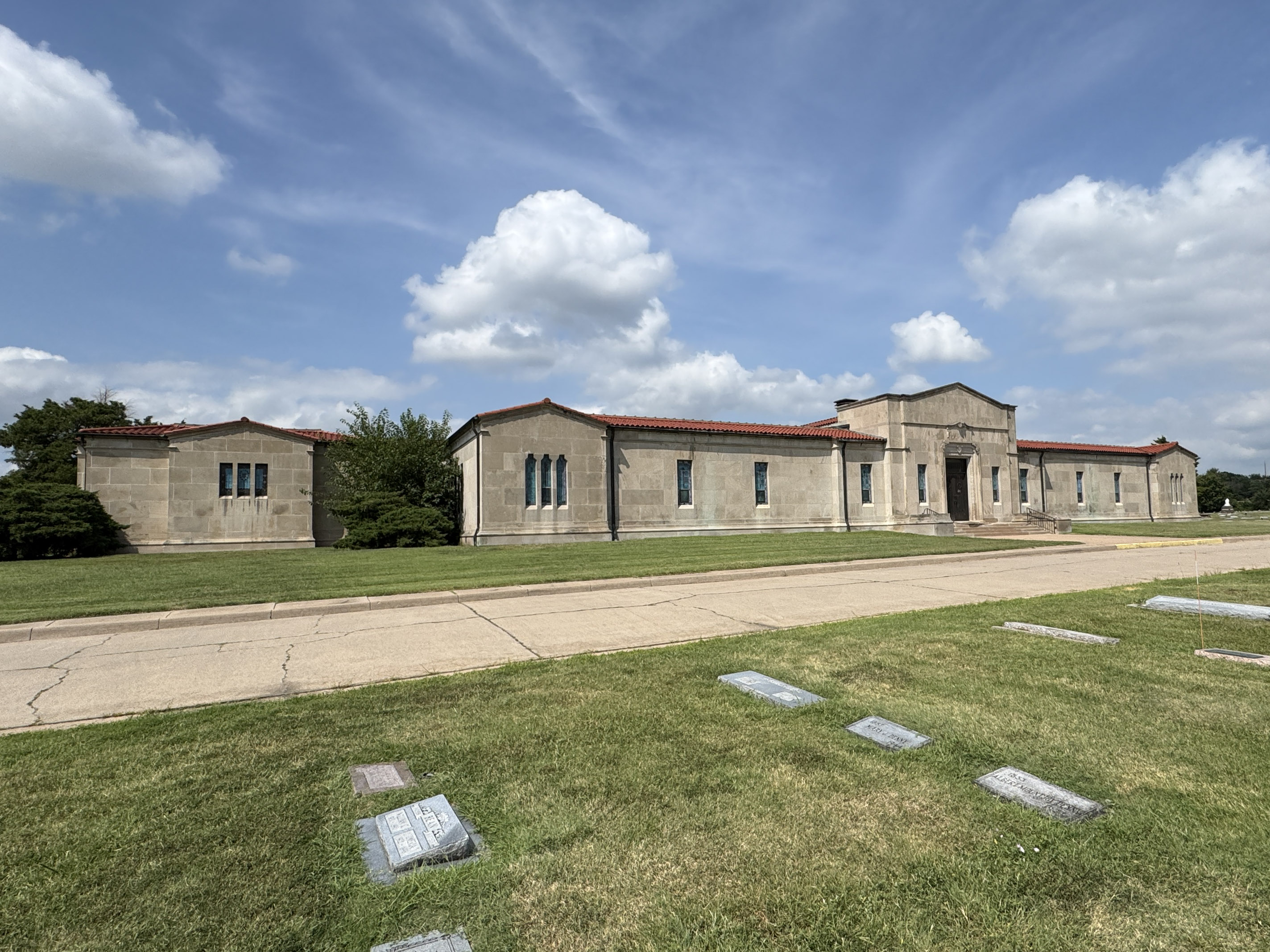
I didn’t know when I photographed Mount St. Mary’s Convent Cemetery that I needed permission to do so. After I found out, I realized that I had technically trespassed, and suddenly felt I was in possession of illegal photos that I probably shouldn’t share publicly (a bit dramatic, I know).
When I reached out to Mount St. Mary’s to get more information about the cemetery, the Sisters were so kind and shared a lot of information about the cemetery and its history with me. They also gave me retroactive permission to post the photos I had taken, absolving me of my transgressions.
I am not Catholic, but I had a great aunt who was a nun. She served with the Adorers of the Blood of Christ on the west side of town, where she is buried. Someday maybe I’ll tell you about my great aunt and her work with the Sisters of St. Joseph and Center of Hope and show you where she is buried, but in the meantime, you can read about Mount St. Mary’s Convent Cemetery here.
A Good Man Undone: The Death of Adam Baker published June 19, 2025

Back when I was visiting Seltzer Cemetery more frequently, I felt drawn to the Baker family and wanted to learn more about them. On the day I took this photo, I decided I didn’t want to wait for the winter to photograph Madora and Baby Baker’s gravestones, so instead I used both of my entire arms to move the leaves aside. Within a few days, the itching started, and eventually both of my arms were itchy, red, and angry. It only took a few minutes of browsing through my photos before I realized I’d made a huge, irreversible mistake.
Thanks to Adam Baker (and my burning desire to photograph the gravestones beneath the “foliage” on the Baker family plot), I will never EVER forget what poison ivy looks like. It took weeks to recover from the intense poison ivy rash and blisters that covered my arms.
I found Adam’s story fascinating, mostly because I lived a good portion of my life assuming that the kinds of demons that plagued Adam were modern problems. The truth is that depression, anxiety, suicidal thoughts, and despair have existed as long as humans have. I also had to wonder what someone in the 1800’s did for a poison ivy rash as severe as mine. You can read Adam’s story here.
What’s That Symbol? Knights of Honor Monogram published June 28, 2024

Finding out what this symbol stood for was such a rewarding and fulfilling exercise for me. I didn’t solve a big mystery for the world or anything, and in my research I found that others had been on the same path as me, stumped by this symbol. The thrill of the hunt was so fun, and when I finally figured out what the symbol was, it felt amazing and I had to share everything I learned. I know there are others out there who have seen and wondered about this symbol, I’ve stumbled across a few of them since writing this. I hope anyone else seeking answers is able to find the information that I assembled in this article and it brings them some satisfaction. You can read more about the Knights of Honor symbol here.
Uncovering Ella Earnest published July 23, 2022

Ella doesn’t have a gravestone, but she should. I stumbled across the announcements of her death one day while searching old newspapers and was fascinated by her story and the way she was spoken of. I searched and searched for all the information I could, following one trail and then another, expanding my search, and then starting over again. I was able to piece together some fascinating information about Ella, her life, and her family. Descendants reached out to me letting me know they didn’t know any of this about Ella, and that they want to get her a gravestone. As far as I know, that hasn’t happened yet, but when it does, I’ll tell you. You can read what I found about Ella here.
I have lots of other favorites, but I’ll leave it at that! Thank you for being here with me and reading my stories. I cannot express how much it means to me!


Share your thoughts