Established in 1870, Highland Cemetery is Wichita’s oldest cemetery. Some early records refer to it as City Cemetery or Wichita Cemetery. After Maple Grove was established across the street in 1888 and Wichita had two cemeteries, people briefly called Highland “the old cemetery.”
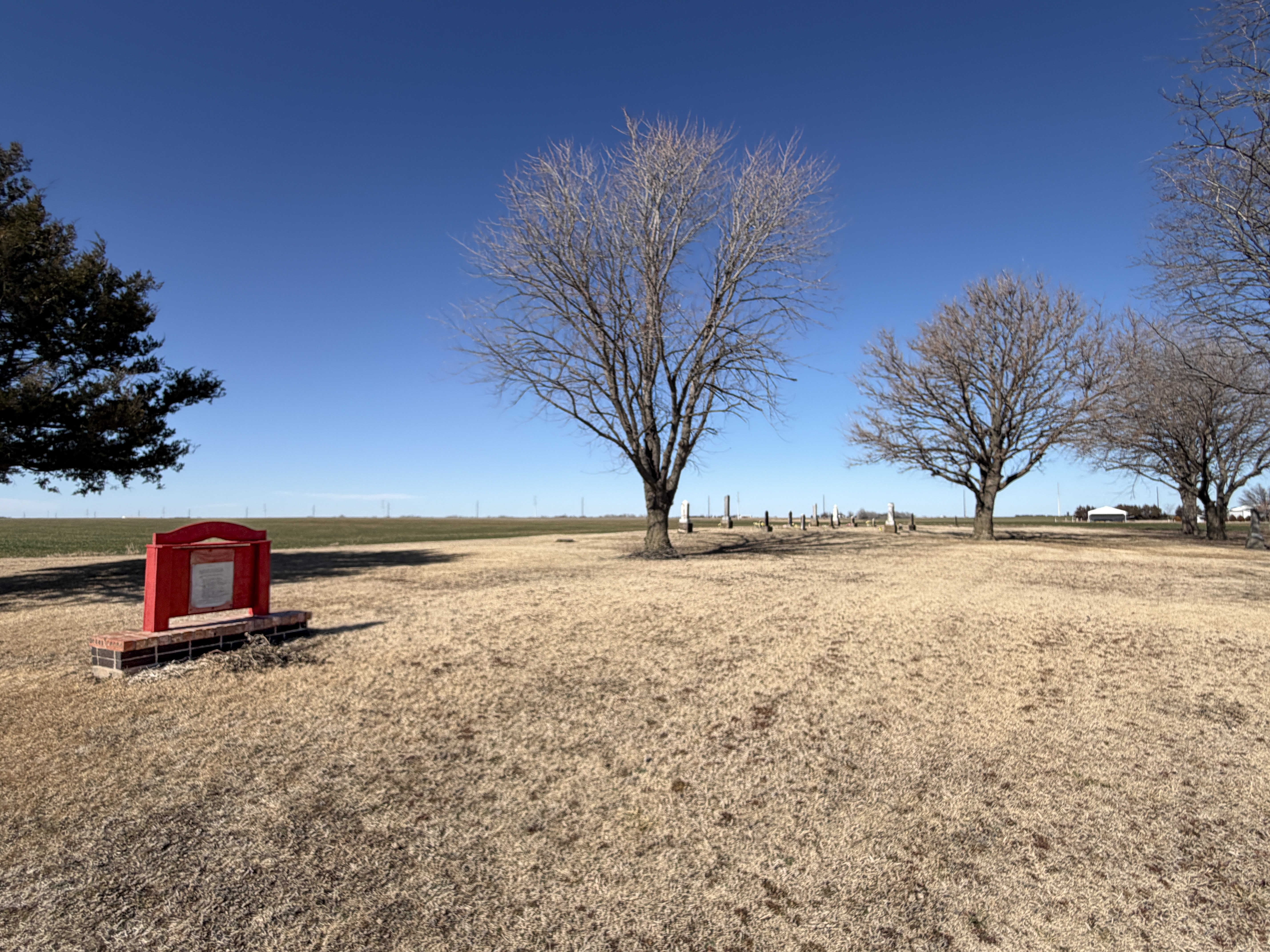
Highland Cemetery is around 25 acres and is considered the “resting place of pioneers,” as many of the founders of Wichita are buried here.

When Highland Cemetery was established 154 years ago on Henry Smith’s homesteaded land, it was on the outskirts of Wichita, located on a hilltop northeast of the valley where Wichita was just starting to thrive below. This was an ideal final resting spot for Wichita’s early settlers. Today, Wichita’s oldest and most historic cemetery has been practically abandoned by the city officials that inherited the responsibility of protecting and preserving it.

How Henry Smith’s Farm Became Wichita’s First Cemetery
Henry Smith came to Wichita in the fall of 1868 and started a sawmill along the Little Arkansas River. He ultimately staked a claim here, started a farm, and built a home on his 160 acres between Hillside & Grove. Henry said he discovered several burials on the southeast corner of his land, which formed an unofficial cemetery. According to some, Smith never wanted a cemetery on his land and that every grave was made “under his protest.” But we know that Henry was willing to at least try to turn it into a business. He sold burial plots on the southeast corner of his land, perhaps before 1870.

In her book Walking With The Wichita Pioneers, cemetery historian Barb Myers shares some of Bill Pennington’s research, which includes the names and death dates of seven people who may have been buried at Highland prior to 1870 (others have estimated the number may be as high as fifteen). At least one of the individuals identified by Pennington, Louella McCampbell, was likely not buried at Highland. Census records confirm that the McCampbell’s did not live in Wichita when Louella died, and her gravestone suggests that she wasn’t buried at Highland, but rather honored with a cenotaph at the gravesite of her parents. You can read more about the McCampbell family here.

Henry was allegedly promised that the cemetery would not be permanent, and the graves on his land would be relocated later to a site hand-selected by the city. We can’t know if this promise was actually made to Henry, but we do know that this mass relocation never happened. Over 17,000 Wichitans, including some of the town’s earliest settlers, remain buried at Highland.

Henry suffered injury from a fall off his front porch, which led to him passing away at his home in 1908 at age 70. He is buried next to his first wife Hattie (nee Royal, 1852-1874) and second wife Sarah (nee Lewis, 1849-1929).

Wichita Cemetery Company
The formation of the Wichita Cemetery Company by Henry Smith in 1872 shows that he saw an opportunity in the cemetery business. He served as president and later as manager. Other board members included his brother William, father Joshua, and brother-in-law John Mossman.

While most agree that the cemetery was established in 1870 and that some burials occurred earlier than that, the cemetery wasn’t platted until 1872, shortly after the Wichita Cemetery Company was formed.

Henry seemed to treat the cemetery like any other real estate business. Once the burial plot was sold, he considered himself out of the equation. The plots were sold with the agreement that the lot owners, not Henry Smith or the Wichita Cemetery Company, would be responsible for maintenance—forever. Hundreds of little squares of land were individually deeded to the purchasers, releasing Henry and his company from any maintenance responsibility, and that was that.
Perhaps Henry didn’t consider that some of the families who purchased plots couldn’t (or wouldn’t) maintain them, or that it really wasn’t feasible to expect people to care for a their tiny square amongst a sea of others. The rural cemetery movement was just gaining steam in eastern Kansas, and there were few guidebooks available for managing a large cemetery.
A.A. Hyde, founder of rival Maple Grove Cemetery, called Highland “spoiled to begin with” due to its unsightly layout and lack of regulation and maintenance. He went a step further and one-upped the “poorly laid out” cemetery by establishing his own cemetery in 1888 across the street. The stark contrast between the two cemeteries was enough to convince many people to abandon their cheap plots at unkempt Highland and purchase new plots at Maple Grove.

Henry sold plots at Highland until 1899, when he sold the Wichita Cemetery Company to the Maple Grove Cemetery Association for $1,500. After the sale, the new owners of Wichita Cemetery Company (Maple Grove) were accused of neglecting the cemetery – and perhaps intentionally sabotaging its appearance so people would purchase lots at Maple Grove instead of Highland.
While some efforts were made over the years to maintain the cemetery, it was mostly by volunteers. Even after Maple Grove became the official owner of the Wichita Cemetery Company, very little was done in the way of caring for the grounds. Some locals recalled the grass and weeds in the cemetery reaching as high as six feet due to lack of maintenance, a problem that persisted until the 1980’s.

Highland Cemetery was abandoned by the Wichita Cemetery Company in 1982, and ownership (and responsibility) shifted to the City of Wichita. Plots have not been available for purchase since 1982, but there are still a handful of interments yearly in lots purchased before the abandonment. The city funds what little maintenance it provides through a trust fund, interment license fees, monument placement fees, and donations.

Pioneer’s “Resting Place” is a Heavily Vandalized Space
Highland Cemetery is the most vandalized cemetery in Wichita, having endured numerous incidents since it was established. Random acts of vandalism and destruction continue to this day, though the damage caused is rarely deemed newsworthy.

The City of Wichita has a trust fund for the purpose of permanently maintaining and caring for Highland, and while they claim the funds are “adequate” for the maintenance they provide, it’s hard to believe that the maintenance includes any more than sporadic mowing and weed eating services.
According to the City of Wichita, the Historic Wichita Board was directed to oversee the cemetery after the City took control of it. However, the Board’s role was dissolved by the City Council five years later in 1987.
The city not only has a specific obligation to care for this cemetery, it has an obligation to protect our historic landmarks, which includes these historic gravestones. City officials have taken little action to combat or repair the vandalism and protect one of the city’s oldest historic spaces.

Because the plots are individually deeded to each respective owner, the repair and maintenance of each individual plot are technically the responsibility of the plot owners or their descendants, not the city. However, most of the original plot owners are deceased. Of their living descendants (if they have them), many do not live in the area. And most do not have an interest in maintaining the family plot.

Volunteers have donated time, materials, and money to help restore some of these historic monuments. They have taken care to use the right tools and equipment to restore them. But before a volunteer repairs or cleans a gravestone, a descendant’s permission is required. And even in the cases where that permission is granted for repairs, sometimes the damage is so extensive that nothing can be done.

Volunteer Efforts to Improve Highland Cemetery
The Highland Cemetery Improvement Association was formed in 1903, consisting of women working under the direction (but without the financial support) of Maple Grove Cemetery owners.
“Had we put this off longer, the old cemetery, except for the occasional lot, would now be a wilderness of weeds. We have raised $5,000 and it has been hard work. We have had an agreement from Maple Grove company that they will help us out. Money comes to them in the sale of lots while we secure nothing.”
The Wichita Eagle, Jul 28, 1907
Women performed what maintenance and upkeep they could (mostly lawn mowing and beautification) with funds they raised for the “permanent care” of Highland Cemetery. The funds – and momentum – of the association died out in the 1950’s.
Friends of the Wichita Pioneers at Highland Cemetery was formed in 2016, spearheaded by author and trained cemetery historian Barb Myers. As a group, they repaired and cleaned over 300 stones. This was arguably the largest volunteer effort to date to restore Highland Cemetery.
In 2012 the gravestone for the three oldest children of Mary (nee Meagher) and her husband, city founder John Marion “Big Jim” Steele was vandalized, and the broken pieces were carried away and discarded in a ditch. Friends of the Wichita Pioneers repaired this gravestone in 2017.


Friends of the Wichita Pioneers was dissolved in 2021, and its assets were transferred to SUVCW Cpl Patrick Coyne Camp 1.
SUVCW Cpl Patrick Coyne Camp 1 is the only currently active volunteer group serving Wichita’s oldest cemeteries. Cleaning and straightening military headstones at Maple Grove and Highland Cemeteries is an ongoing service project that they provide. The group, along with the Daughters of the Union Veterans et al, holds ceremonies annually in both Highland and Maple Grove.
In 2019, the group completed a four-year-long project of surveying and straightening of over 200 Civil War veterans’ markers in Highland Cemetery.
As of January 2024, the group is working to get a Veterans marker for a Civil War nurse whose grave at Highland is currently unmarked.
Highland Cemetery’s First Burials
Who was the first at anything around here has been hotly contested in the past. No one is really sure who was buried on this quarter-section of land first, but Albert Lewellen died in 1868 and is accepted by many to have been the area’s first non-native settler buried here.
Albert Lewellen
Albert was the six-year-old son of Susanah (nee Ryan) and Doctor “Doc” Lewellen. Doc was a dry goods salesman and trader who sold goods to settlers and traded with the Native Americans. Albert died the same year Doc purchased Jesse Chisholm’s trading post, near modern-day 18th Street and Mosley Avenue. Doc left Wichita in 1872 after the death of his wife, Susanah, who shares a plot and a stone with Albert.

Otia English
Otia English, daughter of Osie (nee Foye) and Nathanial English, has also been considered to be the first non-native settler buried here. She died a few months before Albert, but it’s not clear if the English family was in Wichita in 1868. Most historical records have the family in McPherson county until they came to Wichita in 1869. Otia may have been buried here, reinterred here, or this marker could have been placed in her memory.

Other Firsts?
There’s an old story that says the first burial at Highland was a Native American, likely a member of the Wichita band of Osage Indians that Wichita was named after. Bill Pennington’s research suggests that the first burial at the Henry Smith farm may have been in 1856 for an individual named Fannie Crow, but this Crow probably isn’t the Native American mentioned in the old stories. Fannie was probably the daughter of Martha (nee Woosley) and William Crow, and was likely not buried at Highland. Census records suggest that Fannie was born and buried in Illinois, where her family lived until at least 1870.
Notable Pioneers and Others at Highland Cemetery
Because Highland was the only cemetery option for nearly two decades, many of Wichita’s first settlers and earliest notable pioneers purchased (or were gifted) burial plots there. Some of these pioneers chose to be buried across the street at Maple Grove, but there is still an impressive list of individuals here you can visit.

Darius and Julia Munger
Julia (nee Phelps) and Darius Munger settled in Wichita in 1868. Darius was the on-site rep for Wichita Land Company, the business formed to establish Wichita. He built a log house near 9th and Waco, known as Munger House, which is currently on display at Cowtown. Darius and Julia’s burial plot is marked with the same stone.

William Greiffenstein
William “Dutch Bill” Greiffenstein is considered “the Father of Wichita.” Born in Germany, Bill began trading with native tribes around 1850, and had a reputation for being an honest and trustworthy man. He established a trading post along the Cowskin Creek, where Eberly Farms now stands, around 1865. Bill was a generous landowner, known for leasing land for free to those who could improve the community. He also served as mayor of Wichita from 1878-1885.

William Mathewson
William “Buffalo Bill” Mathewson was the original Buffalo Bill. However, most know him as “the other” one. He was given the moniker first, back in 1860 after supplying starving settlers with buffalo meat to stave off hunger through the winter. He never achieved the same level of fame as his rival. Still, he lived a wild and adventurous life on the frontier. He was known among the Plains Indians as Sinpah Zilbah, or “long-bearded dangerous white man.” Bill helped the U.S. government arrange the Medicine Lodge Peace Treaty with southern Plains Indian tribes in 1867, then settled in Wichita in 1868.

Christian and Pauline Kimmerle
Christian Kimmerle and his wife Pauline Gartner were were in Wichita in 1870. Chris was Wichita’s first stone and marble worker. He crafted many gravestones that can be found throughout Kansas. He died in San Diego, California of esophageal cancer in 1914 at age 69. Pauline had the first dining room table in town – a walnut drop-leaf table made by Henry Bolte. Pauline was one of a few early pioneers who saw Wichita rise from a just few houses in 1870 to over 200,000 homes and growing by the time of her death in 1943 at age 90. You can read more about Christian and Pauline here.

Henry and Hermine Bolte
Henry and his wife, Hermine Justine Luening, settled in Wichita in 1870. Henry opened Wichita’s first furniture store and manufactured furniture by hand, including Pauline Kimmerle’s dining room table, said to be the first dining room table in Wichita. He also made coffins. Henry served as the city’s undertaker for a time, driving a hearse and transporting bodies to Highland Cemetery. In early 1896, Henry became afflicted with “la grippe” or influenza. This infection confined him to his home for most of that year, where he committed suicide.

Nathanial and Osie English
Nathanial English and his wife Osie (née Foye) came to Wichita in 1868. Nathanial was regarded as one of the most influential men in early Wichita. He opened the first land office here in 1870, and was a founder of the Wichita Savings Bank, among other roles. English street in Wichita is named for him, and Osie street is named after his wife.

Peter Getto
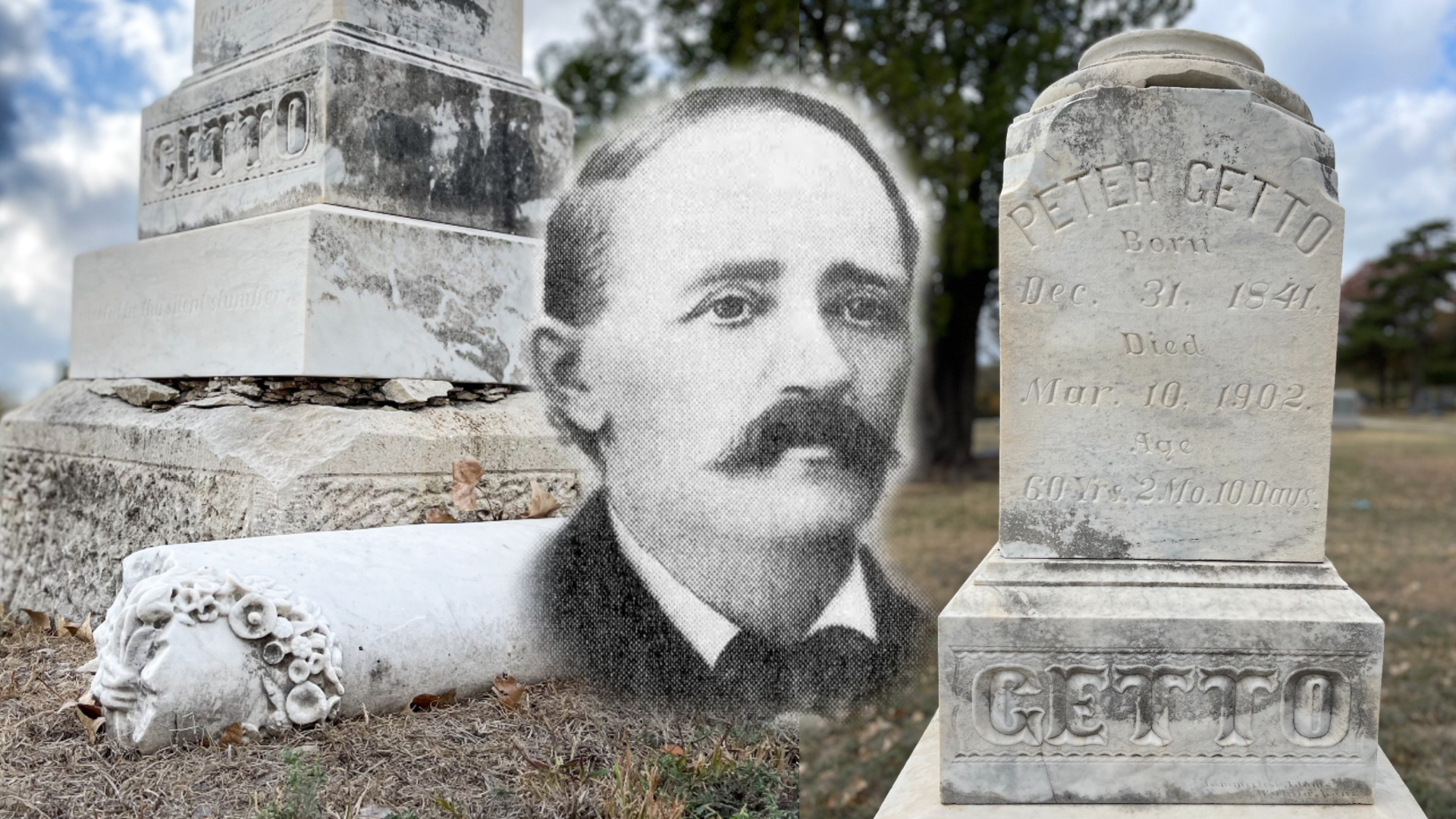
Peter Getto was a Bavarian immigrant who came to Wichita in 1871 with refined carpentry skill and incredible business sense. He owned several businesses including Wichita Wholesale Grocers, Ghetto-McClung Boot & Shoe Co. and the Wichita Soda Company before transitioning into real estate. Getto had a street named after him, but it was converted into a drainage canal.
“Mr. Getto was going home to supper and dropped in to chat with his friend, Mr. Suhm, and was sitting in a chair talking when there came a sudden pain to his heart. He drew a bottle of medicine from his pocket and was in the act of taking a dose when he fell back in the chair. His friends immediately removed him to a sofa and a doctor was summoned, but the man expired before he was laid on the sofa.” Source

John B. Curry
John B. Curry came to Wichita in 1877 and started a watch and jewelry store in downtown Wichita that he ran until his death in 1883. The Irishman’s grave bears two rare marks that you can read about here.

McClees Family
The McClees family were early Wichita pioneers, and have the only private mausoleum at Highland. One of the individuals resting here is Dr. William McClees, who came to Wichita in 1872 and practiced medicine here most of his life. It was said that he never refused medical care to someone in need. He died in 1904 from pneumonia.

The Wichita Mausoleum at Highland Cemetery
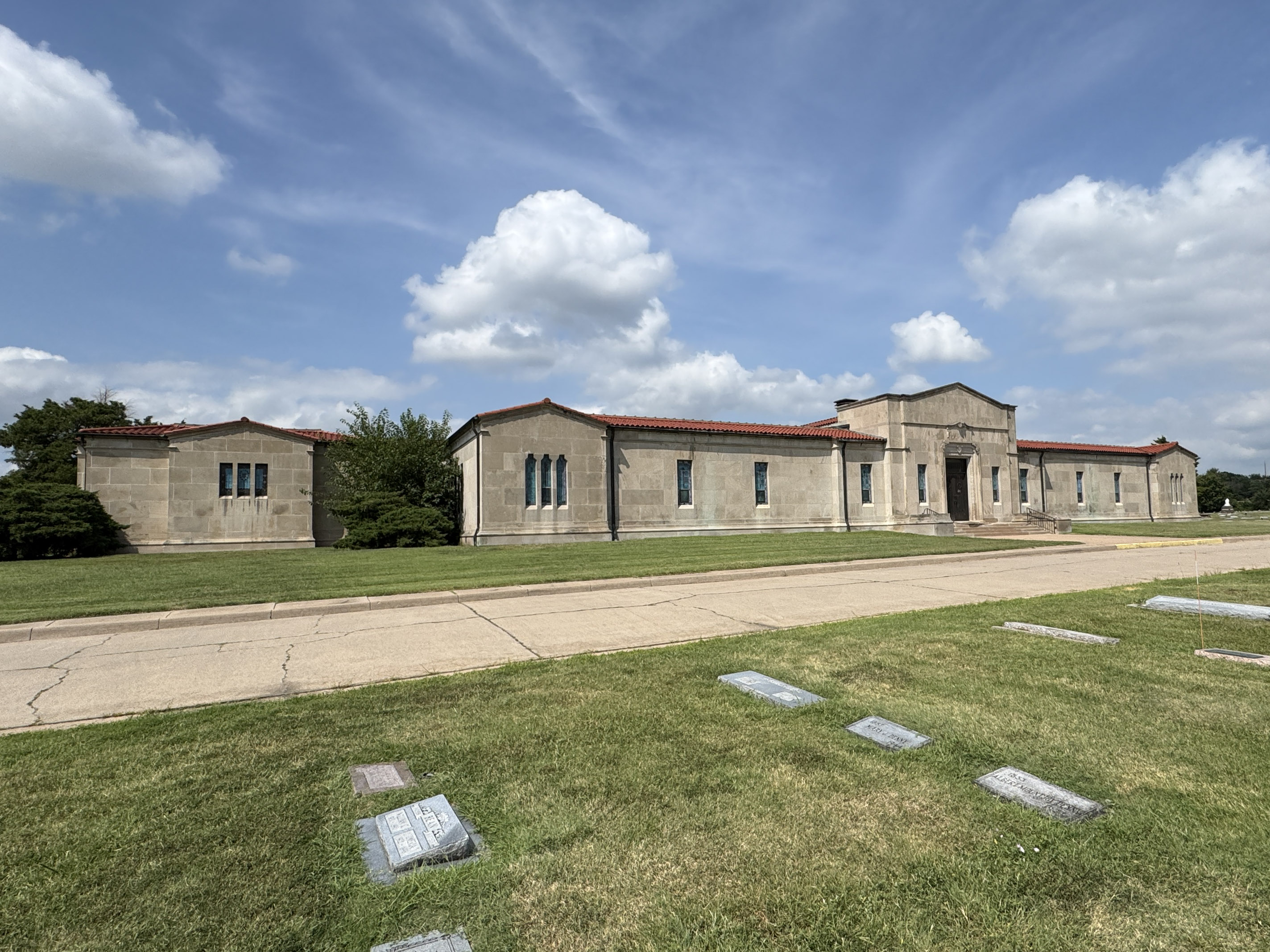
The Wichita Mausoleum at Highland was finished in 1916.


Cemetery enthusiasts who are familiar with those interred here will notice that there are four members of the Black family in the mausoleum who have death dates in the 1850s.

These are relatives of Wichita’s first schoolteacher Jessie Hunter Black and are reinterments from another cemetery.

The mausoleum has been opened to the public on holidays sporadically. It was open for Memorial Day 2024.
You can view more photos of the inside of the mausoleum here.


Resources
“A Grave Subject,” The Democrat, Dec 11, 1887
“A Mausoleum in Highland,” The Wichita Beacon, Jun 12, 1913
“Cemetery No. 1,” The Wichita Eagle, August 10, 1995
Cemetery Rules and Regulations for Highland Cemetery and Jamesburg Park Cemetery, City of Wichita
Chapman Bros. (1888), Portrait and biographical album of Sedgwick County, Kan.
“City to Own Highland Cemetery,” The Wichita Eagle, Sep 22, 1982
“Fence surrounds cemetery to curb recent vandalism,” The Wichita Eagle, Jul 28, 1995
Find a Grave, Highland Cemetery
Friends of the Wichita Pioneers at Highland Cemetery (Facebook Group)
“Grave Damage,” The Wichita Eagle, May 31, 1995
Gresser, J.A. (1919), Burials and Removals Erie Street Cemetery 1840-1918
“Headstone vandals difficult to catch in the act,” The Wichita Eagle, May 5, 1988
“History Rules at Highland,” The Wichita Eagle, Mar 15, 1964
“Is Saved By Women,” The Wichita Eagle, Jul 28, 1907
McCampbell’s Epic Dig Was The Origin of Mammoth Cave School
Myers, Barb (2018), Walking With The Wichita Pioneers
“New Trustees For Highland Cemetery,” The Wichita Eagle, May 23, 1908
“Owners of Cemetery Ordered to Cut Weeds,” The Wichita Eagle, Sep 15, 1982
“Plan Coup on Maple Grove,” The Wichita Eagle, Sep 22, 1907
SUVCW Cpl Patrick Coyne Camp 1, Wichita, Kansas (Facebook page)
The Sacred Who’s Who of Highland Cemetery, Wichita, Kansas (YouTube Video)
“Vandals Targeting Older Cemeteries,” The Wichita Eagle, Jul 23, 1985
“Vandals Topple 20 More Tombstones in Highland Cemetery,” The Wichita Eagle, Oct 29, 1953


Leave a Reply to Connie FotzgetaldCancel reply