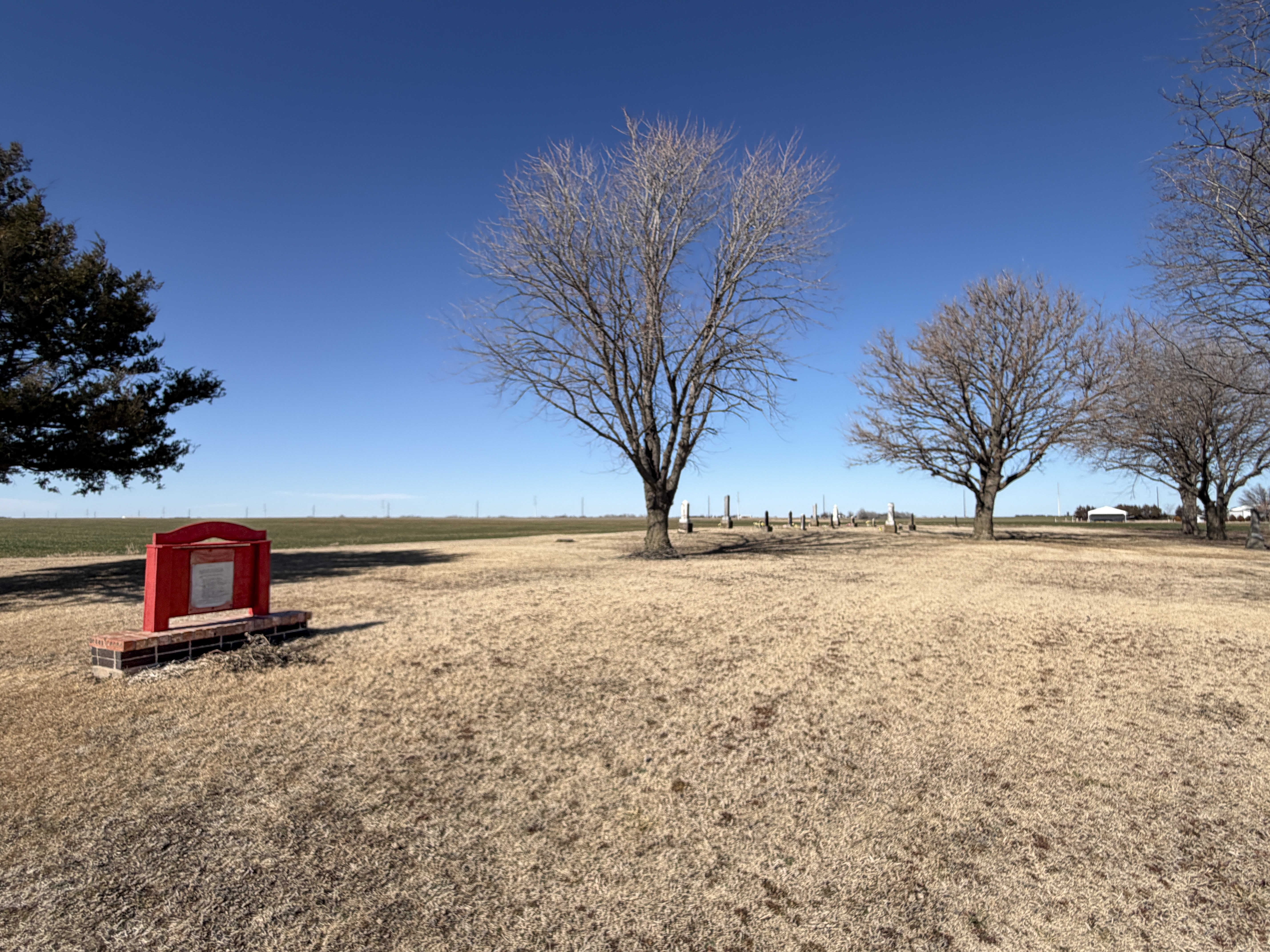
Lutheran Cemetery, also called Whitecotton Cemetery, New Hope Cemetery, Kechi Cemetery, Cottonwood Cemetery, Calvary Methodist Cemetery, and German Methodist Cemetery, might have the most names of any cemetery in Wichita. The cemetery is a small community burial ground covering about three quarters of an acre on the edge of town.

In 1877 when the first known burial occurred here, the cemetery was on rural land several miles outside of Wichita city limits. Now the cemetery sits on one of Wichita’s outermost borders, right where burgeoning Bel Aire challenges Wichita’s boundary line.

One of the cemetery’s other names, Whitecotton Cemetery, is the only alternative name printed on the cemetery sign. The name came from a pioneer farmer and Civil War solider (8th Indiana Infantry, Company K) named Ambrose Whitecotton who owned land near the cemetery.

“Mr. and Mrs. Whitecotton came to Kansas in 1870 and homesteaded 160 acres of land in the eastern part of Sedgwick county and immediately began to improve their home and follow farming in a small way. Money was scarce and the Whitecotton family like the other early pioneers had limited means, and Mr. Whitecotton resorted to every honorable method to earn a dollar. He worked on the streets of Wichita for $1.50 per day and slept in his wagon at night, while Mrs. Whitecotton remained at home on the claim. They felt that they were just getting a start when in 1874 the grasshoppers swept down and destroyed everything that they had, in the way of crops, and left them with nothing with which to subsist during the coming winter. Mr. Whitecotton then took his team and found employment hauling buffalo bones from the Ninescah valley to Wichita. He found these bones in great quantities along the Ninescah river and after hauling them to Wichita found a ready market at $6 per ton. After this he engaged in freighting which he followed until the spring of 1875 when he proved up on his claim and after securing the title was able to borrow $200 for which he paid sixteen per cent. The same year he borrowed seed and wheat and gave one-third of the crop to the man who furnished the seed. From that time on he met with success in farming and stock-raising and accumulated a competence.” History of Butler County, Kansas
An 1882 map (and BLM records) shows that the land where the cemetery is located wasn’t on Ambrose’s land, but was next to it. Perhaps Ambrose had a hand in establishing the cemetery, or maybe the cemetery got the name because the Whitecotton School (also called New Hope School) was nearby on Ambrose’s property.

Despite having a cemetery that bears their surname, no known members of the Whitecotton family are buried here. Ambrose and Susan are buried at Benton Cemetery.
Most of the people buried here are not Lutheran. Several have documented ties to the Methodist church, and a couple of obituaries suggested this cemetery once bore a Methodist name. German Methodist Episcopal events were held in the Whitecotton schoolhouse at one point, and Ambrose Whitecotton was a Methodist. The cemetery may have come under the ownership of the old German Lutheran Church in Greenwich at some point, or had some connection to it that gave it the Lutheran name.

According to Payne Township, no burial records exist today for Lutheran Cemetery, but there were records at some point. The last burial here was in 1923.
Burials at Lutheran Cemetery
Lutheran Cemetery may have originally served a German community. Sixteen of the eighteen known burials here were for people of German descent. It’s estimated that in the 1880’s, up to a third of Sedgwick County settlers were German, the largest European group to settle in Kansas at that time.
Of the eighteen known burials at Lutheran Cemetery, about half of them are from the Haas and Diefenbach families. Both families immigrated from Germany to Kansas sometime in the 1800’s.
Haas Family
Lutheran Cemetery was mentioned in a 1923 news article as a “half forgotten burial place” near Wichita. The article described the gravestones of George and Christina Haas and the graves of three Haas children as they appeared over100 years ago.
“A party of friends were motoring through north of the Crestview club Sunday afternoon when they came across a shabby graveyard in a particularly isolated place. The car was stopped and all got out to examine the markers. A family tombstone bears the names of a father and mother. Below the mother’s name appears the dates 1830-1909. The father’s name has one date below. It is 1821. Is the father still living? If so, he is 102 years old. To one side of the mother’s grave are those of three children, each of whom died before reaching the age of two.” The Wichita Eagle, October 21, 1923
Christina Tober and George Haas were the mother and father mentioned in the article. They were German immigrants who came to Kansas in 1877, and they were Methodists. George and Christina owned land near the cemetery, in the same section as Ambrose Whitecotton.

George did not live to be 102, but he did live to be 96. He died seven years prior to the article being printed, which means his death date wasn’t etched until after 1923. George’s funeral was held in the Kechi Methodist Church and one obituary said he was buried at New Hope Cemetery. Christina’s obituary said that Grandma Haas was buried in the Kechi Cemetery.

Two of the three children’s graves mentioned in the article were probably for George and Christina Haas’ grandchildren, and the third was for their son. The carved stones that once decorated the burial places of these children have been destroyed.

Mary Haas and Adaline Haas, daughters of Elizabeth “Lizzie” Stoltz and John Haas, died in 1877 and 1879. Both girls died before the age of two.

The only record I found indicating that Benjamin was George and Christina’s son was on Find a Grave. Someone once knew his exact birth and death dates, and that he was their son. If true, Christina would have been 45 years old when Benjamin was born in 1875. He died in 1878.

There are ‘Mother’ and ‘Father’ footstones near the children’s graves that may or may not have been George and Christina’s footstones.

The Kimmerle & Adams maker’s mark at the bottom of the children’s broken gravestones are barely visible. Christian Kimmerle was Wichita’s first stonemason.

Diefenbach Family
There are more Diefenbachs buried at Lutheran Cemetery than any other surname, but you wouldn’t know that by examining the stones. Only the grave of Henry Diefenbach is marked. One of his obituaries said he was buried at Calvary Methodist Cemetery.

Henry was the son of German immigrants Jacob and Mathidle Diefenbach. Henry was in the Army from 1903-1913, serving with the 54th Coast Artillery, the Fourth Battery Artillery, and the 94th Coast Artillery. He died in 1918 from typhoid fever. His obituary said he was given a soldier’s burial, but there is nothing on or near his grave today to indicate his service.

Willie Diefenbach, Carlotte Diefenbach, and Naty Diefenbach, as well as Henry’s parents Jacob Diefenbach and Mathilde Nagel-Diefenbach, are all buried here somewhere. Mathilde died giving birth to Naty, who died at three months old.

After Mathilde’s death, Jacob apparently couldn’t handle seven children on his own. He left one of his youngest children with friends to raise. The day Jacob died, the newspaper reported that the son he gave away, also named Jacob, had his name legally changed to Charles Miltner.

The report also says that Jacob was buried in the Kechi Cemetery. Another obituary for Jacob says he was buried in “the German cemetery southeast of Kechi.”
Gretje Ruhaak (1818-1888)
Gretje “Gretie” or Rachel Ruhaak (née Poppenga) migrated from Germany to America in 1855 with her husband Gerd (or George) and two daughters, one of whom died on the voyage. She also had two other children in America, both of whom died in adolescence.

After her husband’s death in 1884, Gretie moved to Kansas with her surviving daughter. She was only in Kansas for a few years before dying at her daughter’s home in Kechi. Church records indicate the Ruhaak family was Lutheran.

Gertrude Ruble (1883) and Mary Ruble (1889)
A footstone that bears the initials G.W.R. is probably for Gertrude Ruble, infant daughter of Sarah Woolms and Henry Ruble, who died in 1883. Another daughter, Mary, died in 1889 and is also buried here somewhere, but she has no visible gravestone today. The Rubles were Christians and of German descent.

Henry lived nearby and was Justice of the Peace for Greenwich, a community just to the east of the cemetery. Later he served as a Kansas state representative, and was said to have personally known Abraham Lincoln. Henry and Sarah are buried at Highland Cemetery.
Wilhemine Stamp (1836-1916)
Wilhemine Katerina Dorothea Hilker was born in Germany and came to America sometime in 1844 as a child, knowing only the German language.

She married fellow German named Peter Smith (or Schmidt) in Missouri in 1853 when she was just 17 and he was 33. According to family history, Peter was orphaned at age three, was raised by his cousins, and came to America when he was 18 years old. The couple came to Kansas together in 1876 with five children and a new grandchild.

Peter supposedly died in Wichita in 1877, but I found no record of that and I’m not sure where he was buried.
Wilhemine married Herman Stamp in 1880. Flipping the script, her new husband was ten years younger than her. The couple made a home together in Harper County, Kansas.
Three years after my father died, my mother, Wilhelmina Katrina Dorotea Smith married Herman Stamp at Anthony, Kansas. Herman was born in Germany and almost ten years younger than my mother.
By 1910, the couple was living with one of Wilhemine’s daughters in Payne Township, near the cemetery. That’s where she died, at her daughter’s home in Kechi, in 1916.

The Williamsons
Sarah Gerard and William Williamson are the only known non-German immigrant family buried here. Their gravestone is on the north side of the cemetery, away from the others.

Sarah was born in Ohio, but her family traces back to France. They came to America early, appearing in Pennsylvania and Virginia in the early 1700’s. Sarah has a familial connection to Gerrardstown.
Sarah had been widowed twice and was a mother of two when she married William in 1870. Her third husband was born in England and came to America in 1850. After Sarah bore six more children with William, he died in 1900, leaving her widowed a third time.
The last person known to be buried at Lutheran Cemetery was Sarah, and her obituary says she was buried at the German-Methodist Cemetery. At least one of their children is buried at nearby Greenwich Cemetery, which has a verified connection to the old Greenwich German Lutheran Church.
Sarah died on the same day The Wichita Eagle published their story about this half forgotten burial place.

Are There More?
There were potentially more burials at Lutheran Cemetery that are not documented. One could be a man named Emil Pfeifer. He was working next to the Whitecotton farm when he was afflicted with Saint Vitus’ dance, or an autoimmune disease that causes rapid, jerking movements. Emil committed suicide and he was buried “on the farm where he committed the rash act.”

The Wichita Weekly Beacon, Wichita, KS, Jun 12, 1878
According to the 1882 map, the cemetery is located south of the Whitecotton farm, technically on a neighbors farm. Was Emil buried here?
Additional Resources
Coast Artillery Companies 1901-1924
Lutheran Cemetery, Find a Grave
Cottonwood Cemetery, Billion Graves
Family sketch of land and ‘Cottonwood Cemetery’ 2015
Payne Township, Sedgwick County, Kansas
I am Anna Montgomery, family history
Emil Pfeifer died, The Wichita Weekly Beacon, Wichita, KS, Jun 12, 1878
Old Payne Booming, The Wichita Weekly Beacon, Wichita, KS, Oct 15, 1879
German M.E. Church Meeting, The Wichita Eagle, Wichita, KS, Aug 7, 1885
The Mrs. Haas Funeral, The Wichita Beacon, Wichita, KS, Feb 20, 1909
Grandma Haas Died, The Bentley News, Bentley, KS, Feb 26, 1909
Christina Haas Obituary, The Wichita Eagle, Wichita, KS, Feb 27, 1909
Jacob Diefenbach Dies, The Wichita Beacon, Wichita, KS, Nov 28, 1914
Changes Name; Father Dies, The Wichita Eagle, Wichita, KS, Nov 29, 1914
Wilhemine Stamp Obituary, The Wichita Eagle, Wichita, KS, Aug 8, 1916
George Haas Obituary, The Wichita Beacon, Wichita, KS, Feb 27, 1917
George Haas Obituary, The Wichita Eagle, Wichita, KS, Feb 28, 1917
Henry Diefenbach Obituary, The Wichita Beacon, Wichita, KS, Apr 22, 1918
Henry Diefenbach Obituary, The Wichita Eagle, Wichita, KS, Apr 23, 1918
Given Soldiers’ Burial at Kechi, The Wichita Eagle, Wichita, KS, Apr 25, 1918
Mystery in Half Forgotten Burial Place, The Wichita Eagle, Wichita, KS, Oct 21, 1923
Sarah Ann Williamson Obituary, The Wichita Eagle, Wichita, KS, Oct 23, 1923



Share your thoughts