Nicodemus Cemetery in Graham County, Kansas is the final resting place for the original settlers and descendants of “the last all black town in the West,” known as Nicodemus.

Nicodemus, Kansas
Nicodemus was founded in 1877 when a group made of mostly former slaves from Kentucky made their way to Kansas, before the Exodusters. Nicodemus was named after a slave who was the subject of an 1864 song titled “Wake Nicodemus.”

The “colored colony,” founded by W.R. Hill, a white man, promised “no saloons or other houses of ill-fame” would be allowed in Nicodemus, which was promised to be among the largest Black settlements in America. He partnered with Black men to make the settlement a reality.

Even though Kansas was a free state, the settlers of Nicodemus met with opposition from some white Kansans. I don’t remember reading or hearing about this opposition when touring Nicodemus, but thanks to old newspapers, we know that “persons adverse” to the settlement were “actively engaged” in attempting to prevent the founders from registering their town company. There was absolutely tension between the residents of Nicodemus and other nearby towns, including Stockton, a sundown town.

Despite the opposition from some Kansans, former slaves came to Nicodemus in droves during the first year, trusting that they would be able to live freely here. By June of 1877, the population of Nicodemus had swelled to over 500 and the settlement was reported to be “in a very prosperous position.” Exodusters who came later saw Kansas as “more welcoming than most of the country.“

Just like most settlements, Nicodemus residents struggled their first winter and accepted help from others, including the Potawatomie. Later, the railroad chose not to come through Nicodemus and land in town was being given away to anyone who would come build. The success of a struggling town on the prairie in the late 1800’s was often dependent on whether or not the railroad came through, and if it didn’t, that was usually the first (or last) nail in the coffin.

Nicodemus had all the comforts other towns did at the time, possibly more. The town even published two different newspapers, Western Cyclone and Nicodemus Enterprise, which were later merged to form the Nicodemus Cyclone. But when the railroad didn’t come through, the town began it’s long and slow decline. The post office and school finally closed in the 1950’s, but still a few families reside in town today. Some are descendants of the original settlers.

Relatives and descendants of Nicodemus homesteaders continue to have annual emancipation and homecoming celebrations at the original town site, and will be celebrating 150 years in 2028.

The town of Nicodemus is a National Historic Site, and five of the original town buildings that remain on the National Register of Historic Places.

Nicodemus Cemetery
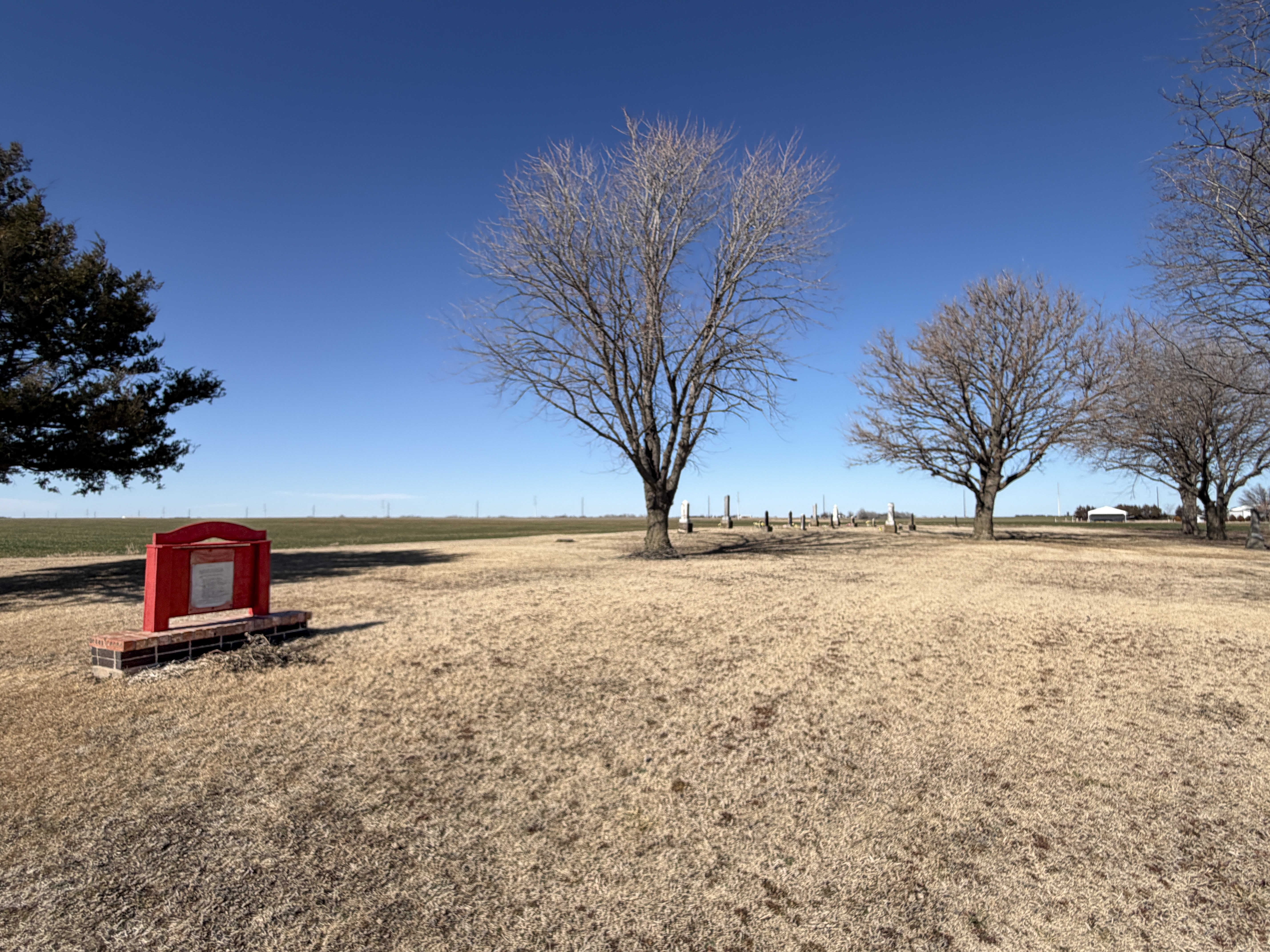
We visited Nicodemus on a day where storms were threatening in the distance, making for some ominous photos.

The “Nicodemus Township History Trail” sign in front of the cemetery shares a great history of the cemetery. We also couldn’t help but notice the warning at the bottom to NOT travel the dirt roads after a significant rainfall (we assumed this would be good advice during a rainfall too, after seeing the condition of the roads). If you can’t read the print in the photo, I transcribed part of it below.

“Nicodemus Cemetery is the original graveyard for Nicodemus settlers, and descendants continue to use it for family burials. The graves farthest to the east are the oldest. The little, white, curved-top headstones indicate Civil War veterans. Tom Johnson, Civil War veteran and one of the original 1877 settlers, and his family are buried here. So is his grandson, Henry Williams, the first child born here (October 1877) in Nicodemus. Also buried here are St. Francis Hotel owners Zach Fletcher, the first postmaster, and his wife Jenny, the first school teacher. Famous barbecue entrepreneur Ernestine Van Duvall rests here, as well as National Football League, Green Bay Packer player, and descendant, Veryl Switzer.” The sign also notes that two other historic cemeteries, Mt. Olive Cemetery and Samuel Cemetery, are nearby.

Another sign that marks the cemetery is a beautifully carved and painted post rock.

I didn’t see any cows nearby, but we kept the gate closed just in case any happened to wander by.

The earliest death date on a gravestone here is 1880, though there were likely earlier burials (especially during the first winter) that were not recorded or marked.
Vaughn Children
Junior Vaughn, or John Vaughn Jr., was the son of John Vaughn and Laura Jackson, freed slaves from Kentucky. The family came to Nicodemus after Junior was born, and he died here in Nicodemus in 1880 a few months after his first birthday. Vergie, who was born here in Kansas after her brother died, was almost two when she died in 1882.

13-year-old Electa Vaughn and her 16-year-old brother Hugh Jerome Vaughn died one day apart in 1911, probably from an illness. I didn’t manage to get a photo of Hugh’s gravestone this day, but it’s similar in size and style to his sisters. Both were children of John and Laura Vaughn.

John Vaughn Sr. was instrumental in literally building Nicodemus because he was a stone mason. At one point, John Sr. was the Trustee for Nicodemus Township. John Sr. and Laura Vaughn are both buried here too, but feeling rushed from the looming storm, I did not wander through that area of the cemetery. You can see their square, slanted-top, granite gravestone, which says “At Rest” at the top, in the foreground of this photo.

One of their other sons, Charles “Doc” Vaughn, was a player for the Nicodemus Blues baseball team. Charles died in 1950 and is also buried here next to his wife.

The Lee Family
Mary was the daughter of Rev. Silas Lee, organizer of the First Baptist Church in Nicodemus, and his wife Luisa (née Jackson).

The extended Lee family came to Nicodemus from Kentucky, too. Rev. Lee’s father, was born a slave in 1813. He married Eliza Pinegar in 1866, and she came with him.

Willis’ gravestone is difficult to read, but appears to say “Wilee.”

Eliza Lee, mother of Silas Lee. On a sunnier day, the faint surname above her first name might be more visible.

Silas and Luisa were living together in Kentucky in 1870 (Luisa’s occupation was “domestic servant”) with Silas’ parents and two of their children. Louisa died young at age 45 in 1890, leaving nine grieving children and her husband.

Bertha (carved “Birth G.” on her gravestone) died two months after performing in the choir at the Easter program that was deemed “the best in the history of the church.”

The Switzer Family
Nicodemus Cemetery has one famous burial, professional football player Veryl Switzer. I could not find his gravestone when we visited, and I looked. I’m almost convinced it wasn’t there, but it probably was.

William (or “Willy”) Switzer was probably a great uncle to Veryl, though I wasn’t able to confirm that relationship. He came to Nicodemus in 1877 from Kentucky, probably the first Switzer family patriarch to establish a home here. Both of his parents were freed slaves, and Willy was their first child born free. Based on what is left behind, William did well here. He has a beautiful Art Nouveau headstone unlike any other in the cemetery.

In stark contrast, the gravestone for William’s son Orin is a simple concrete block that is deteriorating. Orin died in 1940 and at that time his family either could not afford or did not want a fancy stone.

The Fletchers
Jenny Fletcher, the wife of Zachariah Fletcher, was the first school teacher in Nicodemus. The history trail sign here says Jenny is buried here, but I didn’t see a gravestone for her and she does not have an entry on Find a Grave.
“Zachariah T. Fletcher was 18 years-old when he enlisted in the Union Army in Paducah, KY on June 25, 1864. He served with the 8th Regiment of the U.S. Heavy Artillery during the U.S. Civil War.
“Mr. Fletcher was an early settler of Nicodemus, Kansas, having arrived on July 30, 1877 accompanied by his brother, wife and their two children, Thomas H. and Joseph. He was appointed the the town’s first Post Master on September 12, 1877. He was an entrepreneur, opening the town’s first general store, as well as building the St. Francis Hotel and a livery stable in 1880.
“Mr. Fletcher served as a delegate for Graham County to the Kansas Convention for Colored Men. He was also a member of the Nicodemus Cornet Band and Nicodemus Land Company. In 1885, Mr. Fletcher was on a committee to start Nicodemus’ first official school.
“The complex that Mr. Fletcher built became known as “the Fletcher-Switzer House” and consisted of the post office, school, hotel and stable. Many community activities were held there. His wife was the former Francis “Jenny” Smith who served as postmistress of the Kansas Post Office from 1889 until 1894. Her father, Rev. W. H. Smith, was the president of the Colony and founder of Nicodemus.” Find a Grave

His nephew, Fred Switzer (Veryl Switzer’s father), applied for the military gravestone.

Thomas Fletcher was Zachariah’s brother, and according to the National Park Service, Thomas helped his brother build the original limestone building that was the first Fletcher-Switzer house, also know as the St. Francis Hotel, in 1881.

Wellington and Susan Barnett
Wellington was one of the few Nicodemus settlers who didn’t come from Kentucky, but he was born to parents who were once enslaved. Wellington was born in Ohio and was a landowner in Indiana with his first wife. He also joined the volunteer infantry and served in a colored troop unit in the Civil War. On many census records, his race was recorded as mulatto.

Wellington’s gravestone has an interesting symbol at the top. It appears to be a hand pointing downward, holding something. According to Stories in Stone: A Field Guide to Cemetery Symbolism and Iconography, the hand pointed downward sometimes holds a flower or broken chain. This hand doesn’t appear to be holding either, but rather some kind of scroll or ribbon.

His second wife Susan is also buried here, but her grave is not marked.
John Grant
The Freedman’s Bank Records from Kentucky in 1872 said John Grant had a “medium brown” complexion and worked for “anybody” as a laborer. On the 1885 Kansas census, he was listed as widowed, but most others he was listed as single. I didn’t find any indication that he ever married or had children.

John was 85 years old when he died in Graham County at the home of his nephew. His last occupation listed on the census, taken in 1900 seven years before he died, was farmer.

John Weaver
John Aaron Weaver was born in North Carolina and most documents list his race as mulatto. He may have not been born into slavery, despite his birth location. In 1850 at age 19, he was living free in Indiana with his parents and siblings.

John wasn’t among the first settlers in Nicodemus, but he arrived sometime between 1880-1885, probably alone, perhaps after he divorced his first wife. He did remarry, but none of his family members are buried here with him.

At one point, John was a “dealer in all kinds of staple and fancy groceries,” keeping the citizens of Nicodemus supplied with candy, coffee, tea, and other goods and notions.

John’s gravestone features an intriguing symbol, although his is much easier to decipher. A lifted curtain reveals a shining sun peeking over the clouds. The initials “FLT” (which stand for Friendship, Love, Truth) in links below it indicate he was member of the Independent Order of Odd Fellows.

Steven and Amanda Lilly
Amanda “Mandy” Lilly was listed on some census records as “mulatto,” and at least once the census taker wrote her name as Amanda K.E. Lilly. Mandy was born in Kentucky, though I’m not sure who her parents were. She probably married her husband Steven there.

Steven, whose race was also sometimes listed as “mulatto” on census records, outlived his wife by ten years. His epitaph, which partially reads “faithful until the end” may be a personal note to his wife, or a religious sentiment. His name was also printed as Stephen, such as in the newspaper when his role as Nicodemus Township Trustee was routinely published.

The Davenports
According to Find a Grave, Benjamin Davenport (who went by “BD”) has an incorrect military tombstone. He served in Co F., not Co. K under the name Benjamin Wilson, and achieved the rank of Sergeant, not 1st Sergeant. BD was born a slave in Missouri in 1832 on a plantation owned by a human trafficker and enslaver named Rice Davenport. In 1860, Rice reported a personal estate value of $17,000 (which included the value assigned to human slaves, including BD) and a real estate value of $18,800, which would be equal to about $1.3 million in 2025. Around that same time, Rice sold BD to a man in Kentucky with the surname Wilson, which is why BD fought for his freedom under that surname. He went back to his familiar surname after he was freed.

BD married Melvina in 1870 in Kentucky, and to support himself and his family, he worked as a mason and plasterer, likely helping construct some of the very buildings that still stand in Nicodemus today. The couple had at least 12 children together, and BD was documented as having four others with an unnamed “slave wife” in Missouri (Rice reported seven slaves age 13 and under). Benjamin’s name is spelled “Benjiman” and Melvina is “Malvina” on their headstone.

Benjamin and Melvina also buried at least five of their children here, but I didn’t see their gravestones when we visited, or if I did, I did not pause to photograph them. Pearlie, Nancy, Liza, Ellen, and Bennie are all buried here with them.
The Lacy Family
According to Find a Grave, William served in the Civil War with the 101st US Colored Infantry. He lived in and around Nicodemus and also in Linn County for a time.

William fathered at least six children with his wife Juda, who outlived him by nearly 30 years.

The plinth bears the name Goins because Juda married Dan Goins after William died. Dan Goins may have been one a descendant of the mixed-race “lost tribe of Appalachia,” known as Melungeons, as Goins is the most common surname among the group.

Walter, who may have spelled his surname Lacey as an adult, moved to Topeka and was living there when he died. His body was returned to Nicodemus to be buried beside his parents.

Many of the original footstones are still in place at this cemetery, and Walter’s is the one that bears the saying “he was born in old Kentucky where the medow (sic) grass is blue.” Walter was born in Kentucky, just before his parents answered the call for Nicodemus.

Joseph and Annie Jones
Joseph and his wife Annie came to Nicodemus pretty quickly after it was founded, and while they weren’t among the first, “the first free-to-all fight in the town was between Rev. John Anderson and Deacon Joseph Jones in an argument over scripture,” according to an 1887 edition of the Western Cyclone.

Joseph and Annie were probably born in Kentucky, and both were probably born enslaved and freed after the Civil War. One of Annie’s obituary’s noted that her age was unknown due to being enslaved. The gravestone doesn’t contain any date inscriptions for Annie.

Henry Eastman
Aside from learning that Henry Eastman was born in Bourbon County, Kentucky and died in Graham County, Kansas in 1884, I didn’t learn much else about him. His gravestone indicates that he was a member of the 12th U.S. Colored Heavy Artillery, Company E.

Loyd Bibb
Loyd Bibb was a Junior, born into slavery to two slave parents, his mothers name lost to time. He wasn’t always a Bibb. As a child, his family was owned by a different trafficker. At one point, Lloyd Sr. was destined to be sold and shipped to a different plantation. Rather than be separated from his family, he “ran away and hid in the woods for a year. This life was far from pleasant but preferable to a separation from wife and children, for he occasionally had opportunities of seeing them and the hope of these meetings cheered his lonely hours.”

Loyd Sr. was sold a couple of times, ultimately to a man with the surname of Bibb “with whom he had a comfortable home and kind treatment,” yet he was still enslaved. It was considered a privilege that “he was permitted to find places” for his wife and children, who continued to be bought and sold. Loyd Jr. and his brother Green were bought by a wealthy farmer with whom they lived until after the Civil War. Their mother died before tasting freedom. Loyd Sr. brought his children to Kansas to make a new life, and they did. Loyd Sr. died in 1893? and may be buried here too, but he doesn’t have a gravestone.

Daniel Morton
Find a Grave doesn’t have much information about Daniel Morton, but the 1895 census says that Daniel Morton was born around 1816 in Franklin County, Kentucky and that he had a wife named Annie. Annie filed for a pension in 1895 indicating that she was widowed, so that’s probably the year that Daniel died.

Chris Hall
Chris Hall accidentally killed himself when his gun discharged into his face.

Chris was born in 1836, but I didn’t find any documentation indicating where. One obituary said he left a wife and six children to mourn him, but none of them seem to be buried here with him.

There were so many more gravestones here to explore and many more stories to learn. The first child born in Nicodemus is also buried at this cemetery, but I didn’t get a chance to see his gravestone. I hope to be able to go back someday soon and absorb more of our history.
Additional Resources
Nicodemus National Historic Site, National Park Service
Kansas Heritage: Nicodemus (Graham County), Fort Hays State University
The Last All Black Town in the West, The Daily Yonder
Visit Nicodemus, Travel Kansas
Nicodemus National Historic Site, Trust for Public Land
Nicodemus Historical Society records, KU Library
Descendants of Nicodemus, Kansas, preserve history of its formerly enslaved residents, NPR
Rice Davenport 1860 Federal Census Slave Schedule (BD is listed as Male, 28)
Nine Families, The Topeka Weekly Times, Topeka, KS, Jun 1, 1877
Mr. Hill of the Nicodemus Colony, Ellis County Star, Hays City, KS, Jun 14, 1877
Two Hundred Colored People, Ellis County Star, Hays City, KS, Jun 21, 1877
The Nicodemus Colony, The Junction City Tribune, Junction City, KS, Jul 26, 1877
W.R. Hill of Topeka, The Topeka Weekly Times, Topeka, KS, Aug 3, 1877
The local event of the place … Nicodemus, The Standard, Ellis, KS, Sep 22, 1877
Nicodemus Colony are Baptists, The Hays City Sentinel, Hays, KS, Sep 28, 1877
Nicodemus Colony, The Topeka Weekly Times, Topeka, KS, Oct 12, 1877
Colored Folks in Kansas, The Kansas City Star, Kansas City, MO, Jan 30, 1890
Luiza Lee Died, Graham County Times, Hill City, KS, May 15, 1890
Uncle Willis Lee Died, The Logan Republican, Logan, KS, Feb 4, 1892
A sketch of the Life of Lloyd Bibb, The Centralia Times, Centralia, KS, Apr 26, 1895
A Kansas Negro Colony, The Kansas City Star, Kansas City, MO, Jan 26, 1905
Joseph Jones Died, The People’s Reveille, Hill City, KS, Mar 23, 1905
Uncle John Grant Died, Hill City Republican, Hill City, KS, Jun 6, 1907
Chris Hall Killed, Hill City Republican, Hill City, KS, Sep 17, 1908
Accidentally Killed, The People’s Reveille, Hill City, KS, Sep 17, 1908
Wm. Switzer Died, The Reveille-New Era, Hill City, KS, Jun 2, 1910
Walter Lacey Died, The Topeka Capital-Journal, Topeka, KS, Aug 27, 1917


Share your thoughts