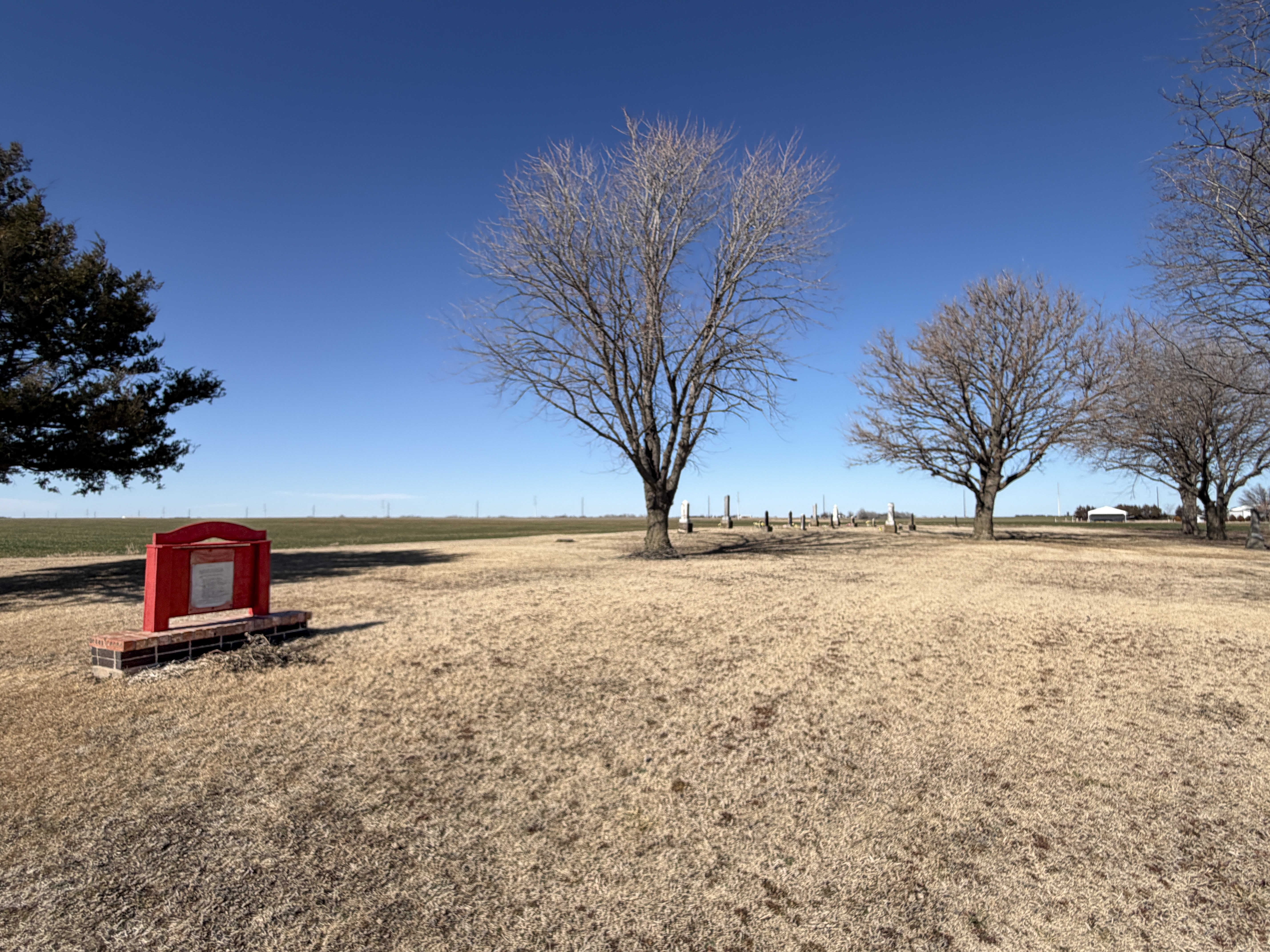
Partlow Cemetery, also called Iowa Indian Cemetery, is located on the Iowa (KS-NE) Reservation directly on the Kansas-Nebraska state line. Half of the cemetery is on the Kansas side, and half on the Nebraska side. The cemetery is owned and managed by the Iowa Tribe of Kansas and Nebraska.

“This place of burial is at the top of a high roll of prairie five miles northwest of White Cloud. To the east of this is located the ground over which the Pawnees and the Sioux fought a finish fight more than a century ago.”
The Iowa Tribe was forced to relocate here from their home in Iowa Point in the 1830’s, so it’s possible there are burials in this area dating back to that time. There are two other cemeteries on the reservation with older gravestones than those at Partlow Cemetery.

Partlow Cemetery is named after settlers with the last name Partlow who once owned this land on the Iowa Reservation.
Burials at Partlow Cemetery
Henry Jones died at the Carlisle Indian Industrial School in Pennsylvania, an institution with a mission to “kill the Indian” to “save the Man.” Fifteen-year-old Henry, an orphan, was at Carlisle for less than a month before he died, possibly from tuberculosis. Henry was originally buried on school grounds, but his body was brought home to the Iowa Reservation and buried in Partlow Cemetery in 2019. Young Henry has the oldest death date on a gravestone in Partlow Cemetery.

The oldest marked original gravestone at Partlow Cemetery today is for another Henry, he died in 1882 at age 45. Henry Washburn was at least partly indigenous, but adopted a European name. Henry appears on early Iowa Tribe census rolls.

Some of the last full-blooded Iowa Tribe members are buried at Partlow Cemetery. Henry’s wife, Mary Washburn (E-no-ah-hah-mee), outlived him by thirty-two years. According to some news reports, Mary was the second-to-last full-blooded member of the Iowa Tribe to die on the Iowa (KS-NE) Reservation.

Photos of Mary’s funeral and burial were published in The Kansas Chief in 1916 in a special about Doniphan County. The newspaper claimed that Kansas was once “infested with countless tribes of vicious and hostile Indians,” that the Iowa tribe was “early conquered and friendly with settlers” and that the “red men were subdued.”

The two men seen in the photo below next to Mary’s grave likely helped to dig it for her. Both men were included on Iowa tribe census rolls, and both have family buried at Partlow Cemetery with Mary.

Elizabeth “Lizzie” Roubideaux-Barada, or Ke-He-Ga-An, was the wife of Antoine Barada, pictured in the article above. She was also the great-granddaughter of Joseph Roubideaux IV, the French founder of St. Joseph, Missouri. When Lizzie died, it was said that she was “one of the last, old members of the Iowa tribe.”

Charlie Barada’s gravestone is difficult to read, but he was the child of William and Anna Barada, and is said to have been “1/16 Native Otoe Tribe, 1/16 Native Omaha Tribe, 7/32 Native Ioway Tribe.” His mother Anna’s maiden name was DeRoin (or Deroine), which was also the last name of some of Joseph Roubideaux IV’s Black slaves.

14th Kansas Cavalry, Company C
There are several men from White Cloud buried at Partlow Cemetery who served in the Civil War with the 14th Kansas Cavalry, Company C. These men were recruited from White Cloud and returned home after the war.
George Campbell’s grandfather was No Heart of Fear (Notchininga), an Iowa Tribe leader and chief. George was born here on the reservation, came home to the reservation after the Civil War, and died here in 1889. There is also a Campbell Cemetery nearby that includes members of the Campbell/Barada family.

George Washington was one of the original allottees of land on the Nemaha Half-Breed Reservation, land set aside for the mixed-ancestry descendants of French-Canadian trappers (like Joseph Roubideaux IV) and the children they fathered with the women of the Oto, Iowa, Omaha, Yankton, and Santee Sioux tribes. George Washington (and Abraham Lincoln) appear on the 1870 Great Nemaha Agency Census (taken by Tommie Lightfoot, pictured in Mary Washburn’s burial photo).

Henry Lee may be the 26-year-old male listed as only ‘Lee’ on the 1856-1857 Nemaha Half-Breed Allotments list. I did not find him on any census records for the Iowa Tribe.

Henry Buffalo, Frank Dupuis, and J.B. Gamble with the 14th Kansas Cavalry, Company C are also buried here.
Chief James A. White Cloud Rhodd
James “Jim” White Cloud Rhodd, or Chief White Cloud, is buried at Partlow Cemetery.

Jim was the great-great grandson of Chief Mahaska, one of the chiefs of the Iowa Tribe. Jim became the youngest Chief of any federally recognized tribe in 1952 at age 17.

Jim was also the Tribal Museum Director for the Iowa Reservation, Iowa Tribe Pow Wow Club member, and Housing Director of the Iowa Tribe, among other important roles in the community.

Additional Resources
Partlow Cemetery – Pocket Sights
Partlow Cemetery – Find a Grave
The Ioway Cultural Institute, Ioway Tribe of Kansas and Nebraska
Iowa Tribe of Kansas and Nebraska – official site
1882 Historical Plat Book, Doniphan County, Kansas – RootsWeb
14th Regiment, Kansas Cavalry – Family Search
1870 Great Nemaha Agency Census by Thomas Lightfoot of the Ioway – Ioway Cultural Institute
Ioway Civil War Veterans – Ioway Cultural Institute
Iowa Tribe of Kansas and Nebraska – Wikipedia
Carlisle Indian Industrial School – Wikipedia
Nemaha Half-Breed Reservation – Wikipedia
Henry Jones Student File – Carlisle Indian School Digital Resource Center
Henry Jones Student Information Card – Carlisle Indian School Digital Resource Center



Share your thoughts