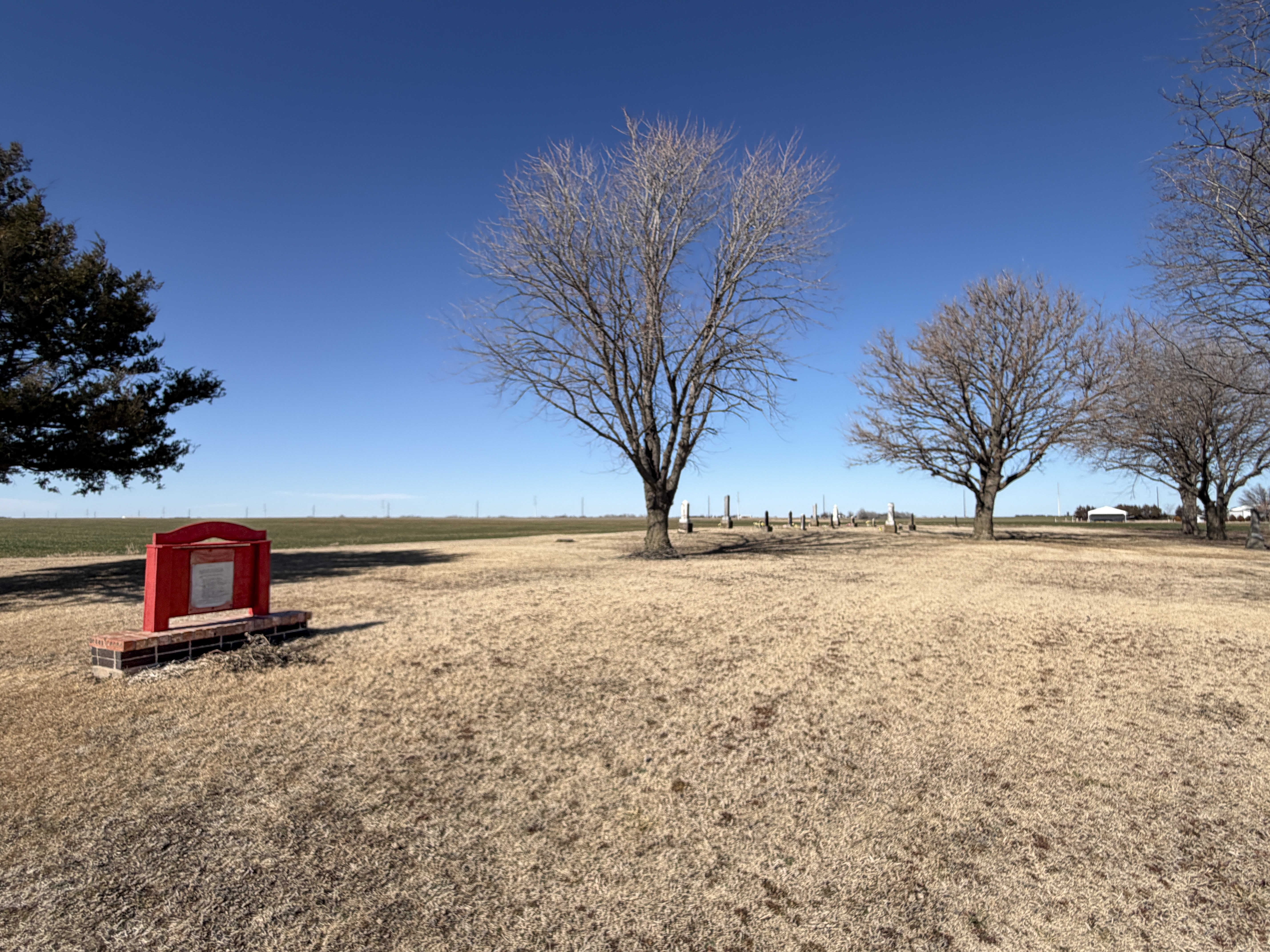
Pumpkin Creek Cemetery is a small cemetery located just east of Coffeyville off Highway 166. It shares a name with a creek north of the cemetery.

Pumpkin Creek Cemetery has around 60 known graves. The cemetery is poorly maintained and the oldest graves have suffered from vandalism, neglect, and time.

A sign in the middle of the cemetery between four graves on a lot covered in asphalt demands our attention. It declares that the Smith family buried here were the pioneers of Pumpkin Creek.

They may have been the first with a piece of paper stating they owned those specific quarter sections of land, but they weren’t the first to set up shop on Pumpkin Creek.
Green L. Canada, for whom Canada Township was named, settled on Pumpkin Creek in 1866 and was one of the areas earliest merchants. There were also other traders in the area in the 1860’s. The oldest marked grave at Pumpkin Creek Cemetery is for a man who established a trading post nearby in 1868, and he wasn’t a Smith.
Within the Smith family plot is the pioneer family’s matriarch, two of her sons, and a grandson.

The Smith Family at Pumpkin Creek Cemetery
According to William G. Cutler’s History of the State of Kansas, Philip Augustus Smith settled on Pumpkin Creek in Labette county in March 1871. Over time, he and his sons acquired at least 480 acres of land along Pumpkin Creek.
Philip was born in Massachusetts in 1809 to a well-known lawyer and judge. He began working as a grocer at age 15, an occupation he held until 1836 when he moved to Ohio. He married Susan Whitney the year before, which may have had a hand in his decision to relocate and change occupations. Susan died in 1839 from yellow fever.
Philip married Janette “Jennie” Canedy in 1841. She bore at least eleven children, two of whom died before the family relocated to Kansas.
One of their sons, Philip H. Smith, was the first in the family to be buried here when he died in 1879. I couldn’t find any information about his death, but he was put on notice later that year for abandoning his Osage land claim in a different township.

Janette (or Jeannette) “Jennie” Bridge (or Bowen) Canedy was born in 1821 in Fall River, Massachusetts. The Canedy family (also sometimes translated as Kennedy and Canady) were Mayflower descendants. Jennie’s lineage can supposedly be traced back to Alexandar Canedy, an immigrant who settled in Plymouth in the 1600’s.
Jennie died from heart disease in 1882.

Prescott Hughes Smith was one of the sons of Philip and Jennie Smith. The young father was just 22 and a few days shy of his second wedding anniversary when he died in 1885, but it’s not clear what caused his death.

The last gravestone in the family plot is nearly unreadable. It was broken at some point and the crude concrete repair covered most of the the carving on the stone. It is believed to be the grave of Scott A. Smith, likely an infant. Scott was probably the son of Prescott H. Smith and his wife Anna L. Carr, making him Philip and Jennie’s grandson. The child’s death date is obscured, and his birth date of July 18, 1884 is barely visible.

Philip, the family patriarch, died in 1897 and is buried in Coffeyville.
Trader John A. Loshbaugh at Pumpkin Creek Cemetery
The oldest marked grave in the cemetery is for John Loshbaugh who died in 1870, a little more than a year before the Smiths settled on Pumpkin Creek.
In 1868, a trading post was established at the junction of Pumpkin Creek and the Verdigris River by a man whose name was written as John Lushbaugh. Pumpkin Creek meets the Verdigris just north of the cemetery, so John’s trading post at Pumpkin Creek may have have been the same land the Smiths pioneered.
It could be argued that John was the original pioneer of Pumpkin Creek.

John was living here in 1868, and he definitely died here months before the Smith family staked their claim. But just because his gravestone is here doesn’t mean he was originally buried here.
John’s gravestone says he died in June 1870, but he appears on the July 1870 census in nearby Westralia. For some reason, his wife and children are listed separately, but on the same page. The 1870 farm schedule shows the family had a horse, a cow, and two pigs on 60 acres in Westralia.

Westralia was just south of where Pumpkin Creek Cemetery is. The settlement only existed for about two years but it had a hotel (Westralia House), a church, and it made the news for at least one murder and a lynching. The settlement of about 100 people even had its own cemetery, but the government moved most of the gravestones in the 1950’s. John’s gravestone may have been one of those.

John was born in Ohio in 1826, and he married Sarah Hartman in 1853. The couple had at least five children who were between the ages of three and fifteen when John died. Sarah died in 1894 and is buried in another nearby cemetery with a matching gravestone.

Other Pioneers at Pumpkin Creek Cemetery
Joseph and Mary Ragan
According to L. Wallace Duncan’s History of Montgomery County, Kansas, Joseph W. Ragan and his wife Mary Edgington came to the wilds of Montgomery county in 1869 and filed a claim. Joseph operated the first hotel in Montgomery county in a town called Clymore (or Claymore), which was also the site of Montgomery county’s first post office.

Clymore was named in honor of an Osage chief, probably Claremore. The town was laid out in the winter of 1868 by Green L. Canada at the site of Lushbaugh’s trading post, so there may have been an entire settlement of white pioneers along Pumpkin Creek when the Smiths arrived.
Joseph Ragan probably did business with John Lushbaugh, and he probably knew Philip Smith.

Joseph died in 1875 at age 45. His wife Mary died at age 51. It’s not clear if they are actually buried in the tree line at Pumpkin Creek Cemetery or if this stone was later placed near former Clymore so their names and contributions wouldn’t be forgotten.

There is a broken stone near Joseph and Mary that may have been their original grave marker, or it may be someone else buried near them whose name has been lost to time.

William and Harriett Tebbs
William Johnston Tebbs was born in Barren county, Kentucky in 1818. He married Harriett Newell Hughes in 1842 and the couple had at least four children, three of whom came to Pumpkin Creek with them in 1869.

Back in Kentucky, William was a slaveowner. When the 1860 slave schedule was taken, William had two slave houses and four slaves – two men in their 20’s, a 76-year-old woman, and a one month old baby girl. It’s not clear who the baby’s mother or father were.
An article in an Independence newspaper in 1896 would tell how William’s son, Harry, reunited in Kansas with an old childhood friend, the son of one of his father’s slaves.

In Kansas, William farmed tobacco and was considered an industrious man and one of the “thriving farmers of Pumpkin valley.” The 1875 Kansas census shows the family living in Howard, Labette county.
William died on his homestead in 1879. It’s not clear where he was originally buried, but his gravestone is here today.

His wife Harriett died a few years before him in 1877 at their home “some ten miles northeast of Coffeyville.” Her gravestone has been broken in two places and lays in pieces beside her husband’s.

The Vassars
A single broken gravestone that faces the overgrown tree line marks the burials of Samuel, James, and Joseph, three sons of William and Mary Vassar.

William Craton Vassar was born in Missouri in 1826 to a Black Hawk War veteran. There is evidence to suggest that William may be a descendant of John Vasser and his wife Elizabeth who arrived in Virginia in 1635.
William married Mary McCready in Iowa in 1845 and the couple had nine known children together. The 1860 census shows the family living in Walnut, Brown, Kansas Territory, so the family probably came not long after the Kansas-Nebraska Act passed in1854.
William was a member of the 8th Kansas regiment, which was organized in August 1861 to secure the Kansas border from the invading south. He received a pension for his disability, which was hemorrhoids.

By 1870, the family was in Westralia, close to the Loshbaughs. The family likely lived here when three of their sons died.
Most people assume that the top part of the gravestone that is now gone was for William and Mary’s 21-year-old son Samuel Jenkins Vassar who died in 1871. The partial age “21 years, 2 months” is still visible and is the only indication of a third person memorialized here. There’s nothing on the gravestone to show Samuel’s six months with the 19th Kansas Cavalry, a volunteer cavalry regiment mustered in 1868 to terrorize Plains Indians and force them into Oklahoma.
James Albert, the oldest of William and Mary’s children, died in 1875 at age 20. His name is inscribed next to another sibling, presumed to be Joseph, but due to extensive damage, only “JOSE” is visible. Joseph just celebrated his first birthday when he died, but we don’t know what year.

Because the Vassars lived in Westralia, this gravestone may have also been moved from another cemetery.
Check out these other cemeteries:
Pierpont Cemetery, Wichita, Kansas
Golden-Eves Cemetery, Harvey county, Kansas
Additional Resources
Legends of Kansas, Montgomery County
Kansas State Board of Agriculture First Biennial Report, Montgomery County, 1878

Share your thoughts