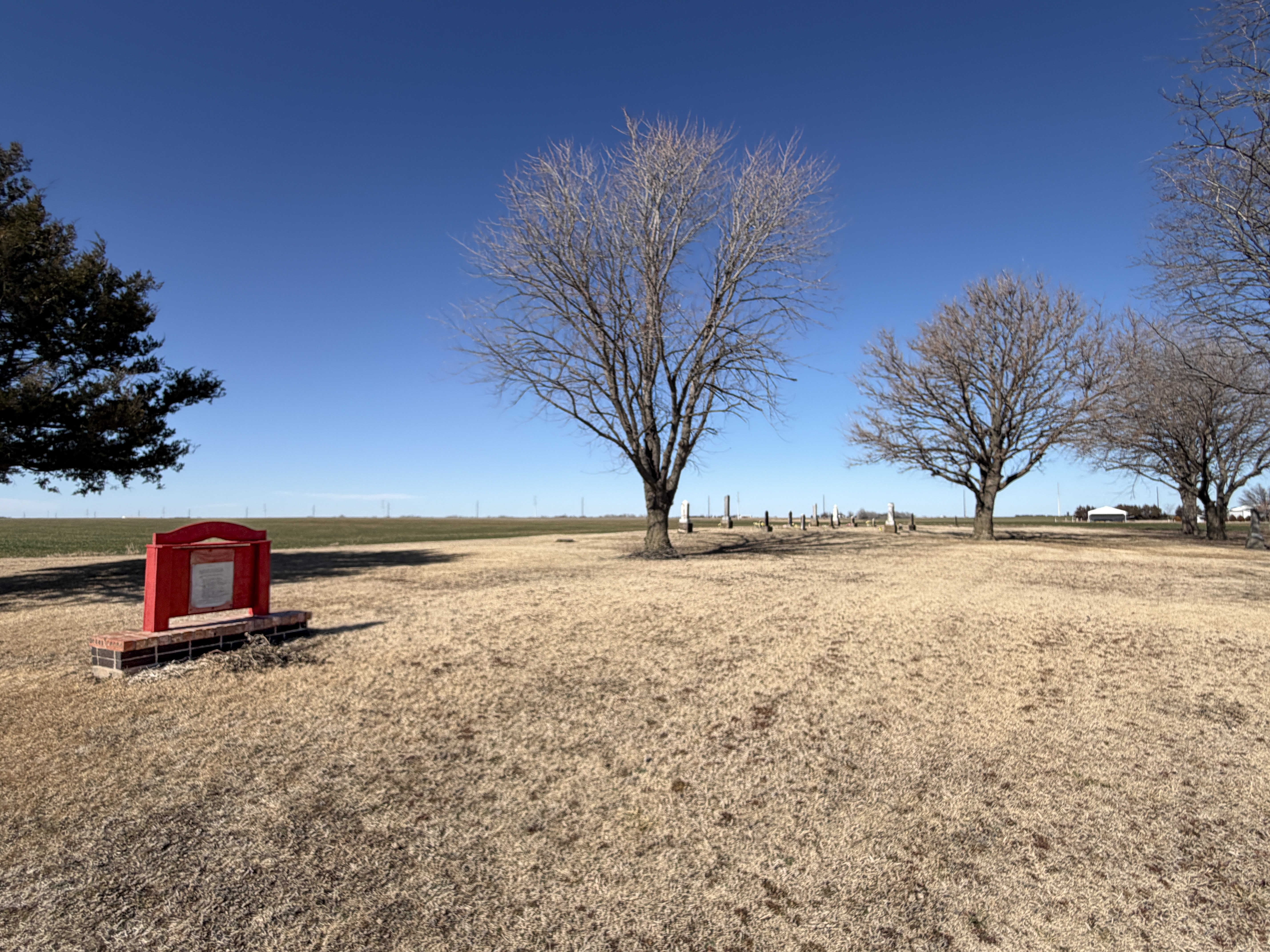
The archway for this little rural cemetery called Quito Cemetery displays the year 1860, which is quite early for south central Kansas.

Kansas become a state in 1861, the now-vanished town of Quito was established in 1870, and the first known burials here were in 1871 for Mahala and Daniel Smith. So what happened here in 1860?
There is a monument here dedicated to early pioneers in unmarked graves.

There were hunters and traders roaming the plains in the 1850’s. Were some of those pre-Kansas pioneers buried here? And if they were, how did anyone know?

Quito, Kansas (1870-1881)
Quito, also called “New Milwaukee” at least once, was the home of Little Walnut Township’s first grocery and drug store, according to the first biennial report of Butler county. No one is left to remember why it was called Quito, who chose the name, and if more than one person ever referred to it as New Milwaukee.
The town was established in 1870 and would eventually have a schoolhouse, a post office, a blacksmith, a church, and other necessities.

Quito appeared on a couple of maps and was mentioned in the newspapers a few times, but it seems to have disappeared just about overnight. It doesn’t look like the railroad ever stopped at Quito, which could have led to its residents leaving for nearby Leon or El Dorado.
The only reminders of Quito are the cemetery and the little stretch of SE Quito Road. According to Legends of Kansas, the town ceased to exist in 1881, although many of the structures remained for years.
Mahala Smith (1848-1871) & Daniel W. Smith (1845-1871)
Mahala and her husband Daniel were the first to be buried at this rural cemetery.

Mahala Miller was born around 1848 in Pennsylvania. She married Daniel in 1867 in Missouri. Daniel may have served in the Civil War, though it’s not clear which regiment he served with. The couple had a son, Samuel, shortly before they moved to Kansas. It was here where she gave birth to a daughter, Mary.
Mahala died on September 11, 1871 from unknown causes. Just inside the cemetery gates, you can see her gravestone that she shares with her husband, pushed over by a large tree that may have been planted on their graves.

Daniel died just three months after Mahala on December 15, 1871. It’s also not clear how he died.

The couple left behind their three-year-old son Samuel and two-year-old daughter Mary. I wasn’t able to trace their lives.

More Burials at Quito Cemetery
Johnnie Hoover was struck and killed by a train when attempting to cross a bridge. He was 11 years old.

John is buried at Quito Cemetery with his father, Carlythe, who died 9 years later of pneumonia.

Laura Melissa was two when died in June 1879 of scarlet fever, and her sister Phoebe Jane was fifteen when she died in November that same year of typhoid fever. They were the daughters of Francis and John Herbert, who moved away and are not buried here. The sisters share a small zinc (also called white bronze) grave marker.

The man credited with introducing the wild turkey into Butler county is buried at Quito Cemetery.

He donated 950 acres of his Butler county farmland to be set aside and managed as a forest by the Kansas Forest Service, known as the Jackman Demonstration Forest.


Share your thoughts