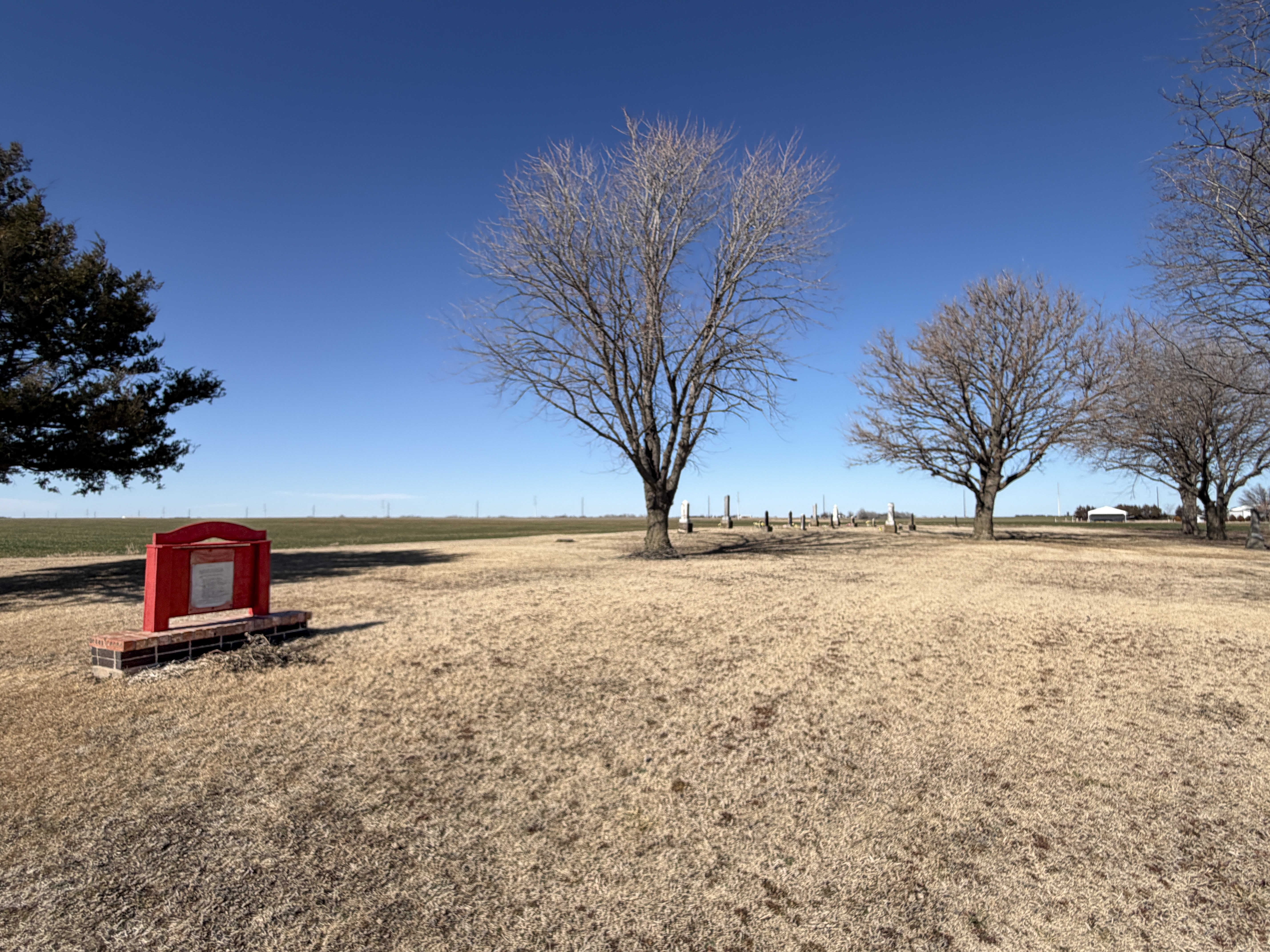
Seltzer Cemetery, or Seltzer Springs Cemetery, was not officially chartered until 1886, but the earliest burial here occurred in 1872, around the time that the settlement of Seltzer Springs started to form.

When established, Seltzer Springs and its cemetery were about nine miles southeast of Wichita. Today, this cemetery is within Wichita city limits. The cemetery occupies about two acres and is maintained by Minneha Township.

An 1882 map of the area does not show Seltzer Cemetery, but by then there would have been at least six burials here, at least according to the stones we can see today.

Seltzer Cemetery was developed on land owned by early settler Thomas Means. His home was once the hub of Seltzer Springs, and his family plot is among the largest here. His land was also used for the Seltzer Springs schoolhouse and the old Seltzer Methodist Church that once sat where Anchor Baptist Church is today.

The Means family did not come to Kansas until 1874, two years after the date on the oldest stone in the cemetery, so there may have already been people buried here when the Means arrived.
According to local articles, Means was a staunch Methodist and together with eleven other residents of Seltzer Springs, he formed a Methodist community in 1875. Their first one-room, wood frame church was constructed on Means’ land, and sat right next to Seltzer Cemetery.

Church members constructed the now-razed Seltzer Chapel in 1882 using local materials and rock transported from a nearby quarry.

That original structure stood until 1961. Locals thought highly of the church, and claimed that “when [the chapel] becomes generally known it will make [Seltzer Springs] a resort second to none in the country.”

Locals also thought the church, or more specifically the church’s Sunday school class, gave them another advantage others did not have. In 1899, an anonymous article in The Saturday Evening Kansas Commoner touted the school’s “remarkable” matrimonial record, and its special ability to make girls “more marriageable.”

Seltzer Cemetery and Seltzer Chapel got their name from a nearby natural spring called Seltzer Spring that was believed to have healing properties.

The spring, located about half a mile from the church and cemetery on what would become Cyrus Webb’s homestead, was once a popular recreation destination and summer resort for nearby settlers. However, the water from the spring is high in sulfates due to the gypsum in the underlying shale, which could give the water a bitter or medicinal taste and cause gastrointestinal issues. Drinking the sulfurous water made at least one local sick enough for it to be printed in the paper.

The residents of Seltzer Springs had ambitions to one day outgrow Wichita and aspired to be known as “the mecca of the west” of which Wichita would be just a suburb. A letter from a Wichita citizen printed in the local paper persuades Wichitans to remember that people once came from all over to get their drinking water from the spring.

The water from the spring wasn’t just used for drinking. Seltzer Springs was a destination for locals. Families and friends would gather at the spring to relax and play.

The spring is still active but is located on private property and not accessible to the public. The community of Seltzer Springs was eventually absorbed by Wichita, and the cemetery is one of a few things left that remains to remind us of this once hopeful community of pioneers.
Burials at Seltzer Cemetery
Thomas H. Means (1837-1926)
Thomas Means, a local Methodist preacher and successful farmer, owned the land the cemetery was established on. The Means family made a massive impact on Seltzer Springs.

Thomas Means was reported to have placed this “fine one thousand dollar pedestal monument” on his cemetery lot in 1906 for his wife Caroline, who died the year before. Three of their grandchildren would have also been buried here by that time.

William Hanshaw (1818-1872)
The first burial in the cemetery is believed to be William Hanshaw, who came to Kansas in 1871 with his wife Marilla (Sweet). William has the earliest death date on a stone here. At least eleven members of the Hanshaw family are buried at Seltzer Cemetery.

The Smith Family
Oliver G. Smith, one of the original founders of the Seltzer chapel, was credited with making young women “marriageable.” It was said that he was proud of his impressive record of marrying off women to eligible bachelors in the area (a subject that many residents of neighboring towns poked fun at). O.G. Smith died in 1919 and is buried at Seltzer cemetery alongside his wife Elizabeth.

Henderson Oliver Smith was one of two sons born to Elizabeth and Oliver.
Henderson was a student attending Southwestern College in the spring of 1894, and he and his roommate had a double date that day. After dropping off the girls, they were hanging out that evening together in their home in College Hill.
According to his roommate, Henderson was cleaning his gun when it suddenly discharged, and Henderson was shot in the chest. He died almost instantly.

Marion was Henderson’s brother. He was just 16 when he died in 1888, about five years before Henderson.

The Baker Family
The Baker family settled in Seltzer Springs in 1871 and made a good life here for many years. But after a nasty legal fight with a neighbor, Adam started displaying some disturbing behavior. His appearance started to become disheveled and he was saying things that didn’t make sense. Then he started trying to hurt himself.

First, he tried to take poison. Then, he found a gun and intended to use it. Eventually he completely lost his mind, and he beat himself in the head with an iron rod in front of his family, causing near-fatal injury to himself. Later, he snuck out of the home and nearly froze to death. His family managed to get him back home, where he later died. His official cause of death was “accident” but his family told everyone it was heart failure.

Adam is buried in this family plot with his wife Madora, his son Arnot, and an unnamed baby. You can read more about Adam here.

Hezekiah Pray (1817–1888)
Hezekiah Pray came to Kansas in the 1880s following his sons, and he found success in Sedgwick County.

He fathered at least nine children with wife Nancy (Collins), and there are at least twenty-one members of the Pray family buried at this cemetery.

Martha Tope (1860-1899)
Martha Elizabeth Wilson was born in North Carolina in 1860. On the 1860 census, she was five months old and her entire family was listed as mulatto. On the 1880 census record, she was listed as “1/4 I,” for one-quarter Indian (or indigenous), along with her siblings and father. Martha’s grandmother, Polly, was said to be Cherokee.

Martha married a man named Addison Tope on January 27, 1889, but her first known child was born over a week prior, on January 16, 1889. She ended up having two children with Addison, though one would die in infancy and is believed to be buried next to his mother.
Martha died on her 10th wedding anniversary. She was just 39.

Alonzo Massey (1851–1885)
At least thirty-five members of the Massey family are buried here, and one if them is Alonzo Tence Massey. Alonzo Massey was an adult when he came here with his parents in 1872. He worked as the undersheriff and jailor in Wichita and “won himself a name and respect by honorable and conscientious service.”

“With all his energies intact and full of hope,” Alonzo went to work in the silver mines in Leadville, Colorado in 1881, but he was quickly back home “a human wreck, his physical vigor utterly destroyed and his mind obliterated.”
Alonzo apparently contracted smallpox in Leadville, and then later he had consumption (or tuberculosis). He struggled for years with the world passing him by, “but his final dissolution was swift and filled with awful agony.” One report said he “suffered from an illness that gave warn of an early departure in life,” and another report said that illness was consumption. He was “buried out on the prairie” where at least 35 other members of the Massey family are buried.

The Patrick Family
The Patrick family have a tragic story. The family patriarch, his wife, and their two twin children died within a year of each other. You can read more about them here.

Additional Resources
Seltzer Springs Grange, Kansas Farmer, Topeka, KS, Mar 18, 1874
Seltzer Church Dedication, The Weekly Eagle, Wichita, KS, Sep 28, 1882
Among Our Friends, Western Methodist, Wichita, KS, Jun 15, 1893
Lillian Mallonee Died, Western Methodist, Wichita, KS, Nov 9, 1893
Henderson Oliver Smith, Western Methodist, Wichita, KS, Jun 14, 1894
Tense Massey is Dead, The Wichita Eagle, Wichita, KS, Jul 30, 1895
Buried Out On The Prairie, The Wichita Eagle, Wichita, KS, Jul 31, 1895
O.G. Smith in Wichita, The Saturday Evening Kansas Commoner, Wichita, KS, Sep 23, 1897
Iowaville Street, The Saturday Evening Kansas Commoner, Wichita, KS, Nov 11, 1897
Passed over the river, The Saturday Evening Kansas Commoner, Wichita, KS, Feb 2, 1899
Death of Adam Baker, The Saturday Evening Kansas Commoner, Wichita, KS, Mar 1, 1900


Share your thoughts