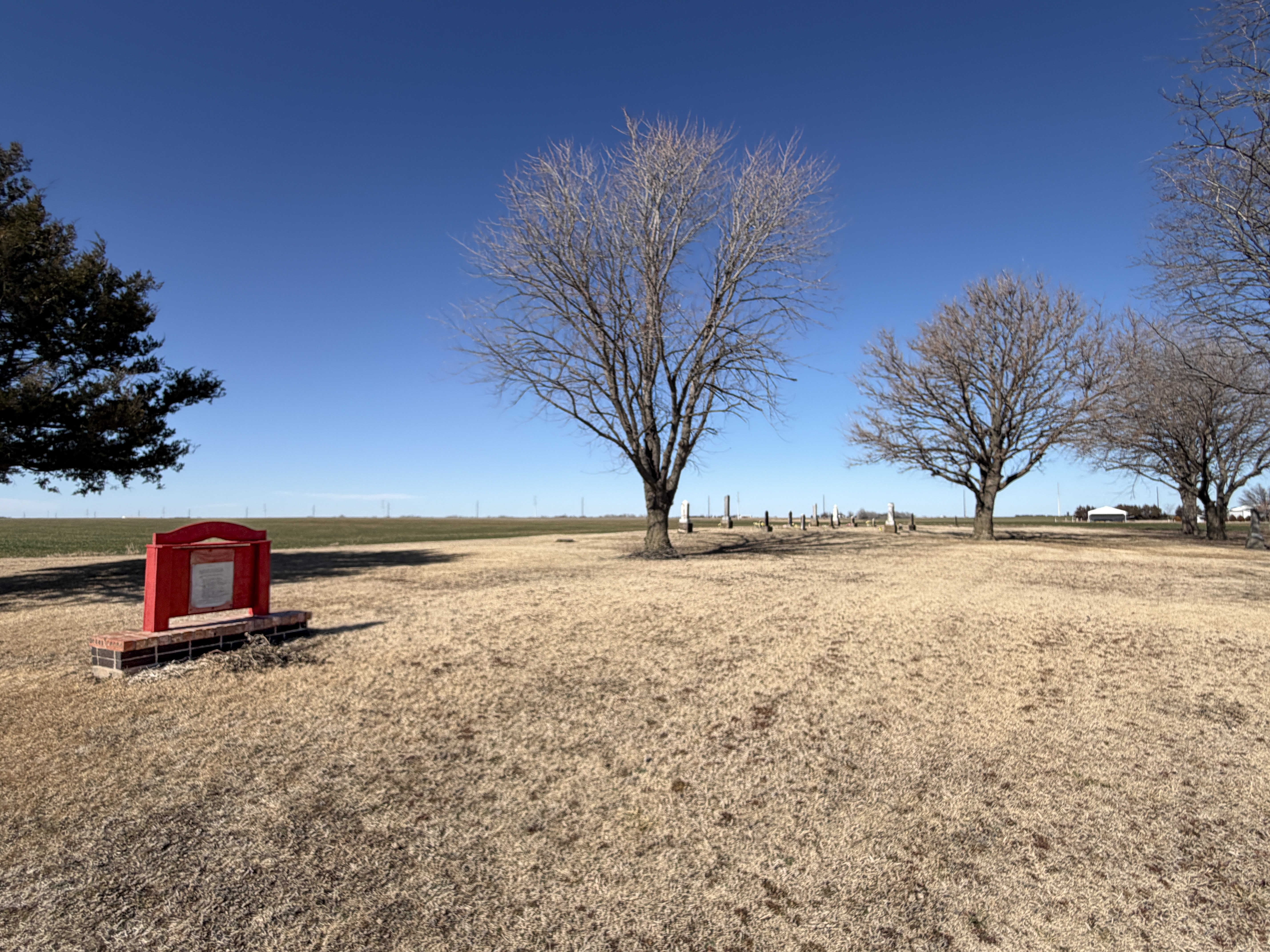
Victoria Railroad Cemetery, also known as Union Pacific Railroad Cemetery, Massacred Railroad Workers Cemetery, and Cheyenne Indian Raid Gravesite, is a small cemetery in Victoria, Kansas along the former Union Pacific rail line.

The cemetery is somewhat hidden, located between Old Highway 40 and 3rd Street. Victoria locals may know the cemetery as the one near the party bridge or “lover’s lane.”
There are at least thirteen, perhaps up to eighteen, people buried here at Victoria’s oldest pioneer cemetery.
Victoria Railroad Massacre
The first seven burials here were for a group of railroad workers who were attacked and killed by members of the Cheyenne tribe on August 1, 1867.
The Union Pacific Railroad Company was building a railroad through Victoria, but the Cheyenne were already living there and had been since at least 1811, well before the arrival of white settlers. The Cheyenne attack on the railroad crew was called at the time by some “the boldest attempt the Indians have made.” The killing of these immigrant railroad workers on native land was considered a necessary “sacrifice,” the price of the “great works” being performed.
All great works are wrought with some sacrifice. Man pays the toll with his own life as the price of his most admirable achievements. The building of the Union Pacific Railroad, that daring project requiring a nation as its sponsor to assure success, was no exception to the rule. Most of the men killed by Indians were buried where they fell. Source

There are three memorial markers here for the seven railroad workers. The first is on a large stone, similar in shape (but not construction or size) to the cairn at nearby Grant Cemetery. This memorial was provided by the Union Pacific Railroad Company.
“This stone marks the burial place of six track laborers who were in the employ of the Union Pacific Railway, Eastern Division and while on duty about one mile west of here were massacred by a band of Cheyenne Indians. October, 1867, erected by the Union Pacific Railroad Company.”

The second is an original hand carved gravestone presumably made by a friend of one of the men who died, probably carved in the late 1860’s or early 1870’s. It was removed from the cemetery for a time, but is now secure behind a plexiglass panel attached to an aluminum frame and stand.

“In memory of Hugh McDonney of Cambridge, Mass. Five persons here to me unknown. To their memory I’ve carved this stone. Killed by Indians in the year 1867. Dock Williams”

The year on this stone appears to contain a 5 corrected to be a 7, and it is signed by Dock Williams, a friend of Hugh McDonough, one of the railroad men killed.

There is another granite marker beneath the stand that includes the names of six of the men who were killed. The shadows made it difficult to get a good photograph of it.
“Union Pacific Railroad employees killed in Cheyenne Indian raid August 1, 1867. Ashley Forman (Wisconsin), Thomas Carney (Iowa), Charles Watson (Canada), John Harrington (Kansas City), Pat Rafferty (Kansas City), Hugh McDonaugh (Denver).”

The seventh man killed, William Gould, is not mentioned on this stone. Some reports claim he was buried at Fort Hays.
Ashley Forman is carved in stone, but that may be incorrect. At least one report said it was P.S. Ashley, the crew foreman, who died. At least one resources says foreman Ashley was sent back to Wisconsin for burial.
The reports also mention a foreman Broadhead who was killed, but he is not known to be buried here and his name is not carved in any stone here.
According to news reports, two of the victims Thomas Carney and Charles Watson had long hair. Both were scalped and left for dead, but one of them was able to crawl back to Fort Hays before succumbing to his injuries there, and it’s said he was buried there.
Mystery Markers
There are five carved field stones here without names. At least one source says the fives stones “mark the graves of 6 of 7 of the men” who were killed in the massacre. It seems weird that five stones would mark six graves, but Adolph Roenigk said there were once seven of these stones here, so they are slowly disappearing.

Seven graves lie in one row. Each has a weather beaten limestone tablet at the head, one bearing simply a deep cut cross, another the words, “Here Lies h–,” as though the wielder of the chisel and mallet was interrupted in his task, or the lettering chipped out by frost … Four unmarked graves lie opposite the seven. In the absence of any information we are left to conclude these low laid ones were also victims of violence in those stirring times. Source
The stone mentioned in the quote above actually has a T, not an h on it. Was this “here lies” marker intended for Thomas Carney, one of the men who was scalped and left for dead?

A man named John Comlyn Chesshyre died in 1876 and was buried here. If one of these stones is for him, it isn’t obvious.
In the spring of 1876, Alex Philip, while strolling over the prairie one evening, heard dogs baking and upon investigating found the body of John Comlyn Cheshire, a young Englishman, guarded by his dogs. It was supposed that he had started for Victoria, early in the evening, had been thrown from his horse and been dragged to death. The body was buried at midnight in the little cemetery by the Victoria bridge. Source

The Seth Family
The Seth family answered the call of Sir George Grant from Scotland and came to America. After making their way to New Orleans, they “left immediately for Kansas via Mississippi River and St. Louis.”
At least five members of the Seth family contracted typhoid somewhere along the way to Kansas. The family matriarch died in St. Louis and was left there while the rest of the family pressed on. Five of them died here in the summer of 1873, just after their arrival in Victoria, established just a few short months prior when Sir George arrived in Victoria with his first load of immigrants.
“In Memory of the SETH Siblings, left their home in Fife, Scotland to join the Victoria Colony, Contracted Typhoid Fever while traveling up the Mississippi River, Laid to rest here Summer 1873.
LOST FOR A TIME, BUT NEVER FORGOTTEN.
Margaret, 27; William, 25; Robert, 24; Thomas, 18; Jane, 16.
They lost their mother, Jeanne Seth, in St. Louis and were survived by their father, John Seth, and three brothers, James, John Jr., and Smith.
Marker placed by the Ernest Seth Family 2008.”

Additional Resources
Union Pacific Railroad Cemetery, Find a Grave
Union Pacific Railroad Cemetery, Historical Marker Database
In Memory Of The Seth Siblings, Historical Marker Database
Victoria, Kansas: Massacred Railroad Workers Cemetery, Roadside America
Pioneer History of Kansas, Adolph Roenigk
Indian Outrages, The Baltimore Sun, Baltimore, MD, Aug 5, 1867
Indian News, The Leavenworth Times, Leavenworth, KS, Aug 6, 1867
Massacre by Indians, The Lincoln County Herald, Troy, MO, Aug 8, 1867
The Massacre Near Fort Hayes, St. Louis-Globe Democrat, St. Louis, MO, Aug 14, 1867
The Late Indian Massacres, The Fayetteville News, Fayetteville, NC, Aug 27, 1867
Massacre Victims are Buried Near Victoria, The Salina Journal, Salina, KS, Jun 20, 1977
Stones mark graves of Indian victims, Olathe News, Olathe, KS, Jun 22, 1977



Leave a Reply to Michael HalfmanCancel reply