Union-Graham Cemetery in Winfield, Kansas is two separate cemeteries. Winfield’s first cemetery was Graham Cemetery (or Winfield Cemetery), established on the land of early settler Dr. W. G. Graham. He sold a portion of his land (perhaps the portion where people were already buried) to the Winfield Cemetery Association in 1872 for the purpose of establishing a city cemetery.
In the late 1890’s, the Cowley Union Cemetery Association purchased additional land from Dr. Graham and established a second cemetery—Union Cemetery—right next to the first one. The cemeteries are two separate entities, but appear as one: Union-Graham Cemetery.

When white settlers began to arrive in the area, this spot by the river (where members of the Osage tribe were already living) seemed like a good place to bury their dead. But the location turned out to be less than ideal. In 1879, the cemetery association was forced to move several graves to make room for the railroad cutting right through the cemetery. And eventually much more land was needed to accommodate a growing—and dying—community.

Dr. William G. Graham

William George Graham was born in 1841 in Holmes County, Ohio to Irish immigrants Alice Finley and John Armstrong Graham. He was the fifth of nine known children born to the couple. The family farmed in Ohio for all of William’s childhood and beyond, and they were successful at it. In 1860 when William was 18, the family farm was valued at $13,500 (about $500,000 in 2024).
Once he was old enough, William attended medical school. He became a homeopathic doctor, so he may have attended Western College of Homeopathic Medicine in Cleveland. One source suggested he went to school in New York, and his future wife grew up in New York, so perhaps he attended the Homeopathic College there (and maybe met his future wife).

Dr. Graham’s mother Alice died in January 1864, and he enlisted in the military four months later in May 1864. He mustered in with the 166th Infantry (4th Regiment, Ohio Volunteer Infantry) for what was scheduled to be a three-month service period. Based on his dates of service, he may have participated in the Overland Campaign, the battles of the Wilderness and Spotsylvania Court House, the Battle of Cold Harbor, and the beginning of the Siege of Petersburg, all of which his regiment participated in during his time of service. He mustered out after five months in September 1864.

Bottom Row (L to R) John, Arthur, Dr. William. Top Row – Moses, Thomas, Alexander. Source: ancestry.com
Fannie Pauline Keyes was born in New York and grew up on the East coast. Her father Alvah was also a homeopathic doctor like Dr. Graham. He had his own medical practice in New York during Fannie’s childhood and teen years, but he also had ties to Ohio—he attended medical school at the Western College of Homeopathic Medicine in Cleveland.
The Keyes returned to Ohio in the early 1860s, and that’s where Fannie married Dr. Graham in 1866. He was 25 and she was 18. The following year, she gave birth to their first son, Alvah, named after Fannie’s father.
The Grahams Go To Osage Lands
After Alvah was born, Fannie was sick, and it must have been bad. The Grahams left Ohio and traveled to better land (Leavenworth, Kansas) for Fannie’s health. By the summer of 1869 she was no better, so as the legend goes, against all the advice of his friends, Dr. Graham procured an ox team and headed south “to bury his wife.” He left Leavenworth with “no objective point (further than [his] graveyard idea).”
On their southward route, they heard of “new country” opening up and decided to head there. The signing of the Sturges Treaty the year before made it seem that the Osage Diminished Reserve, which hadn’t exactly been opened to white settlers yet, was up for grabs. White folks were slowly starting to take the land, and the Grahams decided to join them.

After about a month on the trail, they arrived to the Osage Diminished Reserve at the site of future-Winfield. Fannie miraculously wasn’t sick anymore, so she and Dr. Graham settled along Timber Creek on October 31, 1869. Winfield founder Edwin Manning, early settler William W. Andrews, and early settler and trader Clifton M. Wood and his wife Malinda were already there.
Note: several authors have stated Clifton Wood’s wife’s name was Florence, but marriage records, census records, and original Cowley county organization records show his wife’s name was Malinda.
Winfield Firsts
Dr. Graham is often credited with being the fourth immigrant to settle along Timber Creek (apparently women and children didn’t count), but his wife Fannie is credited by some as being the first “civilized” woman to settle in the area. Technically, Malinda Wood was there first (maybe she was wild). Malinda was also given the title “the first white woman of north Timber Creek.” Later, Edwin Manning’s wife Delphine would be credited with being “the first woman in town.”
Alvah Graham was called the “first white child” in Cowley county, which is probably true. He did arrive as a toddler with his parents in the fall of 1869, and there’s no record of other white children being there at that time.
Dr. Graham erected a log cabin that was located “north of the present cemetery and near the creek and timber” in November 1869, officially making him Winfield’s first doctor. When he died, he was buried “under the cedar tree that stood by his house,” so his grave is located somewhere near where the home of Winfield’s first medical doctor once stood.
Note: some say Dr. William Mansfield was Winfield’s “first druggist and physician,” but he arrived in Winfield in 1870.

When Dr. Graham built his house along Timber Creek, “the Indians were camped all the way from the mouth of the Walnut river up to this place.” These early white settlers allegedly paid Little Osage Chief Chetopah $5 each for the privilege of building homes there (Manning reportedly had to pay $6 for the right to have his log store built).

Fannie and Dr. Graham are credited by some as founding Winfield’s First United Methodist Church in 1871, built from logs cut from their water-powered sawmill. The two of them, along with one of Dr. Graham’s brothers, were said to be the church’s first members. But William G. Cutler’s History of the State of Kansas says a man named B.C. Swartz organized Winfield’s first Methodist Church in 1870. Perhaps the discrepancy over who founded the first Methodist church is due to the splits in the Methodist religion happening during that time (the present version of the UMC wasn’t established until 1968).
Dr. Graham was a founding member of Winfield’s first organized militia. The “Citizens Protective Union” was a group of white men assembled to protect themselves and other settlers from “threatened troubles with the Indians.” They also wanted a little attention, maybe a little help from the government, and a few more able-bodied men to come south. Word of the group was published around Kansas.
There has been no outbreak with the Indians yet, but they are saucy, and are committing petty thefts among the settlers. Where the men are about home in considerable numbers, the Indians do not disturb anyone, but they watch, and when they find the men absent they visit the houses and compel the women to cook meals for them, after which they load their ponies with provisions and leave. When they can find two or three settlers out from other settlements, they make a regular business of robbing them.
The Indians assert that they will not hurt anybody, but that settlers shall not open claims below the mouth of Dutch [Timber] Creek. They have robbed and driven back all who have ventured below that point, and the settlers, knowing their treachery, fear trouble will break out.
The Weekly News-Democrat, Emporia, Kansas, November 19, 1869
Dr. Graham also served as Treasurer of the first town company, was Winfield’s first elected coroner, and served on the first board of trustees of Southwestern College. Some things Dr. Graham wasn’t first at include serving as mayor of Winfield from 1885-1886 (and again in 1891-1892), president of Winfield’s school board in the 1880’s, and sexton for Union-Graham Cemetery in 1918. He also provided sanitary and medical care for Cowley county prisoners beginning in 1874 and was one of the founding members of Winfield’s Knights of Honor lodge.
Lagonda
The first white settlers called the town Lagonda, a name some claim was chosen by Malinda Wood. Many still claim that Lagonda is an Osage word for “clear water” (the same is said about Neosho and the Ninnescah River), but others say it’s a Shawnee term meaning “buck’s horn.”
At least one historical resource says Fannie Graham was in favor of changing the town’s name to Winfield after her hometown in New York, but no records exist showing Fannie in or near Winfield, NY.

Other historical resources state that it was another settler’s wife, Maria Andrews, who was set on the name Winfield. She convinced a Leavenworth pastor named Rev. Winfield Scott to come there, promising him naming rights in exchange for building a Baptist church. This is the official story that made it into the history books (and Rev. Scott did build a stone church there).
One old story tells that some settlers—namely Maria Andrews—were unhappy with the name Lagonda, so the townspeople voted. Legonda lost (though Maria Andrews may have tampered with the ballots) and Winfield became the town’s official name when it was organized in 1870.

Source: Kansas Historical Society
Winfield Cemetery
On the earliest Cowley county map, Union-Graham Cemetery was called Winfield Cemetery. It was the only cemetery serving the city, and at the time, it was managed by the Winfield Cemetery Association.

Dr. Graham came to Winfield “to bury his wife,” and even though he didn’t succeed in that, he may have helped bury some other folks there not long after his arrival.
The first documented burial on the land may have been for an Osage man named Nump-ka-walla, assisted by Dr. Graham. An article from 1876 that details the history of Cowley county includes this interesting paragraph that’s hard to overlook.
Nump-ka-walla lived to see [Edwin] Manning in the legislature, [Rev. Thomas B.] Ross [as] Probate Judge, Cliff Wood a government stone contractor and Chetopah at the head of a gang of Osage Indian horse thieves, and as he could not bear to see his comrades thus disgraced, he gave up his Kinnekepick and passed to the spirit land. He was buried with Indian (summer) ceremonies. Dr. Graham, Dr. [William] Mansfield, Will Hackney and James McDermotte were the pall bearers.
Cowley County Democrat, Jul 13, 1876
Another article from 1903 about the history of the county says the first death in Winfield was the infant son of a Mrs. Hill, and the city had no cemetery at the time. “The child was buried underneath a large tree about two miles north of Winfield where it still lies.” It’s not clear where this baby was buried, but Dr. Graham settled north of town, and this cemetery was sometimes called “north cemetery” in the early days because it was north of town. There are several Hills in the cemetery, but none with a death date prior to the establishment of the cemetery.
There are several gravestones at Union-Graham Cemetery with death dates that pre-date the founding of the cemetery. Some of these individuals could have been early settlers who were buried there before the cemetery was officially established, or individuals who were originally buried on family farms and then moved to the cemetery. There are four stones with death dates that pre-date any known white settler being in Winfield, so these are likely cenotaphs to individuals who are buried elsewhere.
At some point after the establishment of the second cemetery, Winfield’s first cemetery officially became Graham Cemetery. The section of Union-Graham Cemetery that is Graham Cemetery is clearly marked.

The Railroad Moved The Cemetery
In 1879, it was determined that Graham Cemetery was in the way of the St. Louis-San Francisco Railway’s planned route. The Winfield Cemetery Association attempted to have the rail line moved so it didn’t go through the cemetery.

Their pleas failed. Part of the cemetery land was condemned, and bodies were exhumed and moved to make room for the railroad tracks. It’s not clear which bodies were moved, but anyone buried before 1879 was possibly relocated to a different area of the cemetery. There are pre-1879 gravestones on both the Graham and Union sides of the cemetery.


Union Cemetery
The actual history of the establishment of Union Cemetery was a bit difficult for me to confirm, but the official story goes something like this:
The Winfield Cemetery Association wanted to expand Graham Cemetery, and they approached Dr. Graham in 1894 with a plan and a request to purchase more of his land. He refused. The association fought back by passing a bill in the Kansas Legislature allowing cemetery associations to condemn land adjoining theirs. When they approached Dr. Graham with this new law, Dr. Graham informed them that they couldn’t condemn his land because it was already a cemetery. Then in November 1898 the Grahams sold the part of their land next to the cemetery to the Cowley Union Cemetery Association for the purpose of establishing Union Cemetery.
Why did Dr. Graham refuse to sell his land for so many years? What did he mean when he said his land was “already a cemetery?” Was he referring to previous burials, like the one for Nump-ka-walla that he participated in (or was that man ‘buried’ atIsland Park?). Or the baby boy buried at the base of a nearby tree? Were people being buried outside of the original cemetery boundaries already? Was he arguing a semantics issue with the way the law was written? Was he being difficult because he didn’t want to sell?
Union Cemetery wasn’t established until 1898, but in addition to there being numerous gravestones on the Union side that pre-date its establishment, there are references to Union Cemetery in Winfield papers as early as 1884—fourteen years before Union Cemetery was officially established.

Winfield Courier, May 29, 1884
Winfield’s first cemetery may have been referred to as Union Cemetery out of respect for Decoration Day, which was first celebrated in 1868 and was recognized as a holiday in 1873. The Grand Army of the Republic was in charge of Decoration Day activities at the cemetery, and there are a lot of Union soldiers buried there, so the decision to say “Union Cemetery” at certain times may have been done out of respect.
The Cowley Union Cemetery Association expanded the Winfield Cemetery in 1899. This addition to Winfield Cemetery (now Graham Cemetery) was Union Cemetery.

The Union Cemetery side of Union-Graham Cemetery has Union Cemetery markers.

Union-Graham Cemetery
It’s not clear when the name Union-Graham Cemetery was adopted. The two cemeteries that make Union-Graham Cemetery have been owned by the City of Winfield since 1918, but records for each cemetery continue to be kept separately. The community has been using a joint name and treating the two cemeteries as one since at least 1905.
Plots are no longer for sale at either cemetery, but there are still one to four interments each year in previously purchased lots.
There’s no plans (and no room) for a future expansion of Union-Graham Cemetery, but the city is considering adding a columbaria in the next twenty years.
The Grahams Buried at Union-Graham Cemetery
Dr. Graham and Fannie are buried at the site of their old house along Timber Creek “under the cedar tree that stood by [their] house” on the Graham Cemetery side of Union-Graham Cemetery.

Dr. Graham’s son Alvah was a member of the first graduating class of Southwestern College in 1889. He became a lawyer and married Julia Smith in 1894, daughter of Rev. John Smith, Methodist church minister and early settler in Winfield. They had two daughters, Helen and Elizabeth, who both went to Southwestern. Helen Graham Little Theatre is named in honor of Alvah’s oldest daughter who was a professor at Southwestern for 41 years.

Alvah, his wife Julia, and daughter Helen have modest gravestones in the family plot.
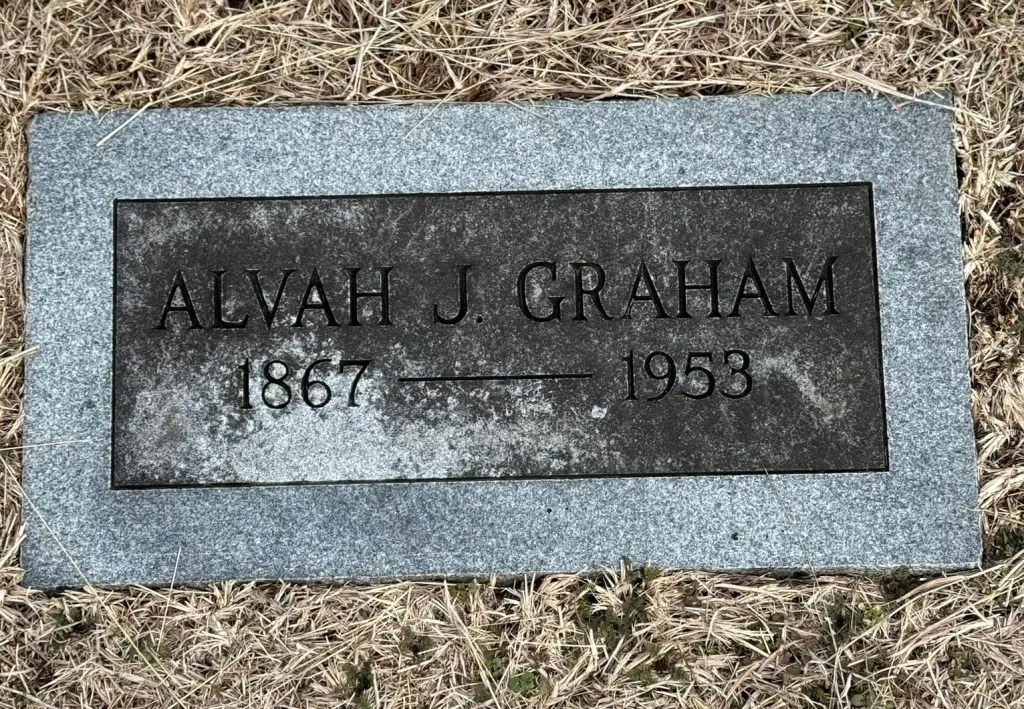


Fannie and Dr. Graham had one other child, a son named Earnest in 1873. Earnest married Lillie Wood in 1895. They farmed in Winfield and had no children. Earnest retired from farming and they bought a house in Winfield in 1925. He died in Hot Springs, Arkansas of congestive heart failure in 1937 at age 64. Lillie lived at their home in Winfield until her death in 1966.

It’s not exactly clear when Dr. Graham’s family came, but at least one of them was in Winfield in 1870. Four of his brothers—Moses, John, Alexander, and Thomas—and his father John all died in Winfield. Some of Fannie’s family came too. Carrie May Keyes, Fannie’s sister, was 17 when she married Dr. Graham’s brother, 30-year-old Alexander, in 1877.

Top Row: Moses, Thomas. Bottom Row: Dr. Graham, Arthur, Alexander. Source: ancestry.com
John Graham, Dr. Graham’s father, died October 15, 1873. His monument is among the tallest in both cemeteries. He is in the Shannon family plot with his daughter Margaret and son-in-law Thompson, next to his grandson Thomas.

Dr. Graham’s brothers are buried with their wives.


Early Settlers Buried at Union-Graham Cemetery
Out of the four original white settlers along Timber Creek, Dr. Graham and Clifford Wood are the only ones who were buried at Union-Graham Cemetery. Edwin Manning is buried at Highland Cemetery with his wife Delphine. William Andrews moved to California with his wife Marie around 1900 and died there in 1918.
Clifton Wood was born in Ohio and was living in Kansas Territory as early as 1860, according to census records. He built “the Old Log Store” for Edwin Manning, which was Winfield’s first structure and where the county’s first celebration was held. He died in 1890 at age 53 from tuberculosis.

John Mentch wasn’t mentioned as one of the original settlers, but he was probably the Mentch that helped Dr. Graham build a water-powered sawmill in 1870, and he may have also been a boot & shoe maker. The Mentch’s owned 160 acres just north of the Grahams, and Timber Creek ran through both of their claims.

Colonel J.D. Land, youngest son of Amanda Duncan and James H. Land, has one of the earliest grave markers in the cemetery. James was one of the original directors of the Winfield Town Company founded on January 13, 1870 (although the 1870 census shows the family living in Indiana June).

Prettyman Knowles, his wife Virginia and six of their children traveled to Winfield from Indiana in December 1869. Their names are on the Cowley county organization records as “actual residents of Cowley county” in 1870. The “first and only bridge over the Walnut river” was built at Knowles’ ford in 1872. Prettyman died in 1899 and is buried with several family members, including his wife and at least three of his children.

Resources:
- 166th Infantry Regiment (United States), Wikipedia
- 4th Ohio Infantry Regiment, Wikipedia
- A New Cemetery, Winfield Daily Courier, Aug 25, 1899
- A New Old Cemetery, Winfield Daily Free Press, Sep 17, 1910
- American Medical Education in the 1860s
- ancestry.com
- Blackmar, Frank Wilson: Kansas, A Cyclopedia of State History
- Bottorff, Bill: Winfield Cemeteries
- Cemetery Lots For Sale, Winfield Daily Courier, Jan 1, 1900
- Chisum, Richard: The Economic Development of Cowley County, Kansas (1947)
- Condemn Right-of-Way for LL&G Railroad, Winfield Daily Courant, Aug 22, 1879
- Condemning Land for East-West Railroad, Cowley County Monitor, Aug 15, 1879
- Cowley County Historical Society, Dr. W. G. Graham
- Cowley County Heritage (1990)
- Cowley County Organization Records, Kansas Memory
- Cutler, William G.: History of the State of Kansas (1883)
- Dr. W.G. Graham Has Passed Away, The Winfield Daily Free Press, Jan 3, 1914
- Edwards, John P: Historical atlas of Cowley County, Kansas (1882)
- Find a Grave, Union-Graham Cemetery
- Historic Tour of Union Graham Cemetery, Winfield Kansas (YouTube)
- History of Cowley County, Cowley County Democrat, Jul 13, 1876
- Kansas News, The Leavenworth Bulletin, Jun 1, 1870
- Kansas State Historical Society Biennial Report, 1879
- Legends of Kansas, Cowley County
- Mayors of Winfield, Cowley County, Kansas 1873-2000
- Meeting of the Stockholders of Union Cemetery, Winfield Daily Courier, Jun 2, 1894
- Order of the March, Winfield Courier, May 29, 1884
- Ready for Business, Winfield Daily Courier, Nov 8, 1899
- Removing Bodies, Winfield Courier, Nov 13, 1879
- Slawson, Robert G: Medical Training in the United States Prior to the Civil War (2012)
- Winfield Cemetery Association, Winfield Courier, Jun 19, 1873
- Winfield Cemetery Association, Winfield Courier, Jul 24, 1874
- Winfield Cemetery Association Meeting, Proposed Railroad Line, Cowley County Monitor, Aug 8, 1879
- Winfield Comprehensive Development Plan 2020-2040
- Winfield, Kansas (Wikipedia)
- Winfield, Winfield Chamber of Commerce (2017)
- Winfield’s Early Days, The Industrial Free Press, Sep 3, 1903


Share your thoughts